Saturday, February 23, 2013

England


Last week I went to England with my class (1SB, which means junior year (1) of the science track (S), along with a class of 1L (literature track), a class of 1ES (economic-social track), and a class of 1STMG (science and technologies of management). We were in two different buses, so it wasn't too crowded, although I did get extremely fed up with the slow pace and amount of waiting that always results from disorganized school trips and too many people who don't know what they're doing.

We spent the first day in London and saw the British Museum and a Museum of Natural History, neither of which were terribly interesting given the packets of worksheets we had to fill out and the sleep-deprived state we were in after the night crossing of the English Channel. Yes, we had rooms with beds, but I can assure you that not very many people slept.

After London, we drove to Warwick, where our host families were. I have heard that many English host families are extremely odd, because French schools pay these families to feed and lodge French students for a week, and thus they are sometimes seedy people in need of a little extra cash instead of the kind, educated, philanthropists that make up the majority of volunteer host families. I have to say that our family held true to form. My favorite moment in that house was when Julia (my BFF – best French friend – and roommate) opened a cupboard in our room and screamed.

Moral of the story? Never look in closets of people you don't know.

Our host was an elderly retired woman and, for the first half of the week, her middle-aged daughter who was back from Dover for a visit. I've heard most Brits come across as cold and overly proper, and conversely Americans seem like golden retrievers to Brits, that is, overly friendly and a little stupid. Our interactions followed this pattern pretty well. I was shocked that she didn't eat with us, cleared off the table, and acted like we were at a hotel, and I got the impression that she wanted to keep our socializing to a minimum. Oh well. We ate decently despite all I've heard about terrible English cuisine, and we had beds to sleep in and a shower, even though she insisted that we shower at night. It was certainly an experience that reminded me how lucky I am with my host family in France.

On Monday we went to Cadbury World, where I dressed up like a pirate



and otherwise made a fool of myself, and we toured the chocolate factory. As far as museums and factory tours go, it wasn't bad, because we got free chocolate. In the afternoon we walked all over Bournville to take advantage of the snow.

SNOW! 


For a California girl, even a measly few centimeters was pretty exciting. We had snowball fights all day, with even our adorable physics teacher participating.
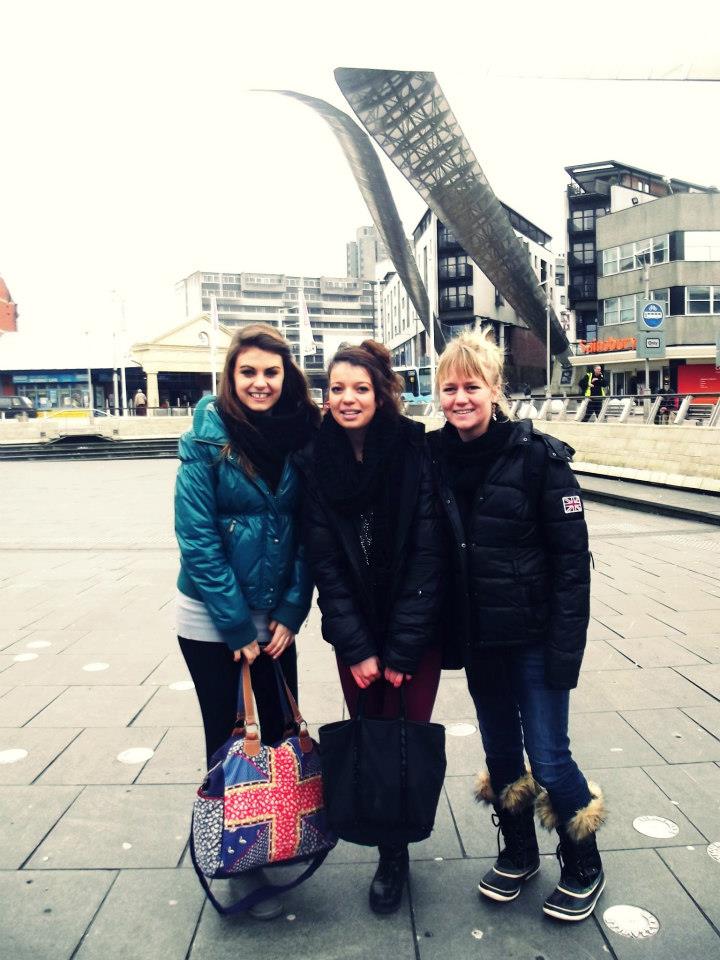
Me and Julia:
 This is me trying to warm up my hands after a snowball fight:

I don't have any good pictures of the snowball fights because no one wanted to endanger their camera, but here's a picture of my adorable physics teacher with my two BFFs:


On Tuesday we drove several hours to Manchester, a gloomy industrial ghost-town of sorts that was a big deal back when England was a major textile exporter, but now there's not much of interest in Manchester. We went to the Museum of Science and Industry (MOSI), and I can't say that was too interesting either. I like science, don't get me wrong, but it was a museum aimed for either a little younger or a little less educated than I. The one great thing about it was a skit put on for a group of elementary school British kids, that immediately drew the attention of all the French high school kids and we ended up doubling the size of the audience. It was to explain how trains work to little kids, under the form of a mean boss trying to educate a clueless worker who wanted to become a conductor. The clueless worker was one of the best comic actors I've ever seen – I really think he missed his true calling by working at a museum instead of being a stand-up comedian. He had the greatest facial expressions and had amazing slapstick skills, managing even to fall off the train looking convincing and comical without hurting himself.

The other great thing about MOSI was playing hide-and-seek in the trains with my friends, which meant we didn't fill out our worksheets at all, but we were already sick of spending our England trip complying to such busywork.


Wednesday was my 18th birthday! We spent the morning at the Museum of Transport in Coventry, which was nice if you like old cars but I don't, and then in the cathedral, which was bombed out during WWII and rebuilt afterwards. In the cathedral there was a beautiful Boston piano that I was drooling over since it's been half a year since I last got to play. When someone mentioned to my physics teacher that I used to play piano for a church and was longing to play, he said “Hmm.... that would be a good birthday present, wouldn't it?” and wandered off to find the caretaker of the church. He was an extremely kind old gentleman with a great (very British) sense of humor, or humour I suppose: “Do you, by any chance, have your birthday exactly once every year?? Astonishing. Because you know, I am very old, and by now I seem to get TWO birthdays per year.” Long story short, I was soon seated at an open piano, and sat down and played the one thing my fingers remember how to play: the introduction to Bring Me to Life, by Evanescence. You can see in this picture my other BFF and roomie took (let's call her Rihanna, since all names in this blog are made-up) that everyone in my group had sat down in the pews to watch me.

Fortunately I hadn't even noticed them, or I wouldn't have been able to play anything at all, but suffice it to say that I was quite embarrassed upon looking up, realizing that I had an audience, and realizing I could play literally nothing else unless I had some sheet music in front of me. That was awkward kids, thanks for listening to my 30 seconds of playing...

After the cathedral, we had the afternoon free for shopping in Coventry in the snow! I was pretty excited that it was snowing. In the words of my physics teacher (translated, of course): “You don't ever get snow in San Francisco, do you?” I guess it may have been obvious by the way I was trying to catch snowflakes on my tongue and finding patches of unmelted snow to make snowballs with. Fortunately I've pretty much come to terms with making a fool out of myself. We took a group picture on the steps of the old bombed-out cathedral, and you can see that it's snowing, but it was warm enough that the first half-hour of snow just melted into cold slushy mud on the ground. I'm the idiot on the left who thought the picture was already taken and stopped doing the wave. And I have a snowball in my hand by carefully finding a bit of unmelted snow on some priest's tomb!


So, shopping – we went to Primark, which is the English version of something in-between Forever 21, Target, and Walmart, that is, reasonably fashionable garments in vast quantity and variety, but made very cheaply, of low quality, and costing so little you feel like you're stealing. In short, the perfect store for teenage girls. My own personal philosophy of clothes (in response to people who like buying high-end clothes that will last longer, and thus having to buy fewer of them) is that I am extremely hard on my clothes and will destroy them whether they're from Walmart or Neiman Marcus (that's a high-end store, right?), and besides I get bored of my clothes after a few years anyway and would prefer to buy new ones and waste less money overall on nice clothes. Anyway, so while Rihanna was buying out the entire store, I got myself a 1£ sweater among other nice cheap things and a birthday present for Sarah the other American, whose birthday is 5 days after mine. We went to a few other more upscale stores like New Look, that still had massive sales and were therefore not too expensive. New Look made my day because I met a cashier whose father comes from Sunnyvale, my city of origin! Our conversation went something like this:

Her (upon hearing our accents): Where are you all from?
Rihanna and Julia: France
Me: California
Her: Really? Where in California?
Me: Around San Francisco.
Her: Whoa! My dad comes from Sunnyvale.
Me: What?? Really? I'M from Sunnyvale!

It really made my day. Mostly I did not feel more at home in England than in France, even though I certainly had a refreshingly high level of confidence just going into Starbucks and ordering a coffee. (Yes! I still have a different accent than what they're used to, but at least I don't sound stupid now!) The different accents meant that I had to ask the English host family to repeat what they just said about as often as I have to ask French people to repeat themselves, and because I feel so at home in my host family in France, that meant England was not as refreshingly almost-the-US as I thought it might be. But it certainly was nice to find someone who actually knows Sunnyvale. As my mom says, San Francisco is just “some dinky little town to the north of us.” But it's actually a good point: San Francisco may be our “the City,” just like how for anyone in New York or New Jersey, “going into the City this weekend” means NYC. But the city of artists and hippies and social outrage and narrow European-style streets is actually a world away from the quiet, competitive, intellectually-elitist, technophile, suburban Silicon Valley that actually represents my home. //End tangent.

Here are my friends and I at Starbucks. Starbucks is even more expensive in England than in the US, but it was worth it. Chai latté, yum.


Oh and here's a picture of the weird lunch I got:


I was planning on getting some Subway, but seeing the pictures on the menu, it was clear that Subway wasn't at all like how it is at home – they only have soft white fast-food bread, and it looked more like McDonald's sandwiches than the garden of deliciousness that it is back home. So I ordered a meat pie from somewhere sketchier, and it would've been good if they hadn't given me four ladles of gravy on top. I guess I should really learn to say “Stop! That's enough gravy!” at some point, but I kept watching with fascinated horror to see when he would stop.

After shopping and Starbucks, we went home and had dinner. After dinner, there was no cake. If I were a host family, I never would've let an exchange student's birthday go by without cake, but I already mentioned she was a little weird. Then we went immediately to bed, obviously, without partying at all because we are good kids.

How does it feel to be an adult? Well, pretty good. February 13th especially was heart-warming, because my classmates sung Happy Birthday to me (in English!), my teachers gave me a card, my friends gave me presents and sweet cards as well, and everyone really made me feel like a loved and accepted part of the class, which as an exchange student means I've succeeded, and as a human being makes me feel warm and fuzzy inside.
Look! I have friends!


Otherwise? Nothing has changed in the short term. I'll continue to go to high school, continue to be under the responsibility and direction of my organization, my school, and my host family, and continue to not have adult superpowers. (Wait, you mean I don't get to know all the secrets of the universe upon turning 18? What is this BS? I thought adults had all the answers! What's the point of getting old if I don't become omniscient?)

But it actually does feel a little different. I have the right to do what I want to within legal bounds (except buying alcohol once I return to the States) and the right to make my own decisions. On legal grounds, I'm now on the same footing as adults, and feel that that will make a difference for me when adults disrespect me just because of my youth. One interesting thing about my recent delve into feminism is that I've never felt disrespected because of my sex, and therefore have wondered from time to time if this (feminism) is still an issue. But age-ism, something that no one writes books or holds protests for, is something I've been acutely aware of all my life. Have you ever noticed that adults have the “right” to be downright rude to children, even unprovoked? I'll take a recent example:

The other day, my host sister and I walked out of our high school through a different door than we usually use, the door next to the administration offices. The secretary immediately got up and yelled at us. This is a translation, but I'll do my best to not change the tone at all: “Excuse me??? [indignantly] Stop right there! Since when have students have the right to use this door?!? This door is only for teachers and parents, not children.” This was delivered in a tone of voice I would describe as angry, indignant, disparaging/derogative, and rather affronted. Now, imagine for a moment that the door was only for staff, and that parents weren't allowed through. What would the secretary have said if a parent walked through the door? Probably “Excuse me, sir/ma'am, but this door is actually only for staff. I'm sorry for the inconvenience, but if you could go around to the other door that's located on the other side of the building, that would be much appreciated.” The parent would get the benefit of the doubt, while teenagers are always instantly seen as delinquents, or deliberately defiant and disobedient. The truth is that we didn't know we weren't supposed to use that door, and that we've never done anything against that secretary. She had no right to be so rude to us, and it was only socially acceptable because we're kids. I'm not even going to go into the fact that the only reason students are barred from using that door is to lower us, to make us less human than the adults. Just focusing on the actions of the secretary will do for a blog post that supposedly was about England, not ageism.

Nothing has changed since – I still look like a 16-year-old. But now I'd really like it if I could start fighting against this ageism, this very common discrimination that has never been seized by the media. A simple “Excuse me?” and request to be treated more politely might go a long way, you never know. The knowledge that, according to the law, I am now just as much a person as any other human being on the street is valuable just because of what it does for my confidence. I'll let you know how this plays out in real life. //End tangent.

Thursday was Stratford-Upon-Avon, which was the most uneducational potentially educational event of the entire trip. Stratford is very commercialized and touristy, and is more about the gift shops than about Shakespeare. What I particularly disliked was that there was no mention whatsoever about the mystery of who Shakespeare actually was, although after a quick consultation of the all-knowing wikipedia gods (link) I discovered it's a much less credible conspiracy theory than I had always thought. I had heard of the “Who was Shakespeare really?” question as an educated person's acknowledgement that we don't really know, but apparently it's a less well-supported theory than that. Anyway, the gift shops were okay, and there was a river with really aggressive geese, and we took another group picture:


That night we had fishsticks, which is one of the very few foods I simply cannot force myself to eat. I'm not a picky eater and am willing to eat foods I don't like, just because for me it's not the end of the world (nourishment is nourishment), but I simply can't eat fishsticks. Ick.

On Friday we said a breezy goodbye to our host. I heard in other families they got hugs or touching farewell sentiments, but we formally thanked her for her hospitality and walked out the door without looking back. It's a shame I didn't get along with her, because I had really been looking forward to discussing things in my native language. I would've been ecstatic to fall into a family interested in politics or philosophy or linguistics or anthropology or history or any of the many humanities subjects on which I can speak passionately, if not expertly. But alas, we did not exchange any more meaningful ideas beyond her telling us that we weren't allowed to take our showers in the morning.

We spent Friday in London, seeing Buckingham Palace,

 the changing of the guard, and the poor dehumanized soldiers who make up the guard.

Most of us have heard before of this phenomenon – the soldiers who aren't allowed to smile or react in any way to the tourists milling around and taking pictures with them.


I completely didn't expect this, but seeing this young soldier up close just made me sad. What a job it must be to have to endure that all day: the endless colors and noise and laughter turning around you, but being isolated behind a poker face and the interdiction of interaction. It's dehumanizing, the way people swarm around him and take pictures with him, acting like he's an object. I think that's why it's fascinating to us, because it's a human being acting like an object, but to me it was depressing and not funny, sort of a sad metaphor for life. We try to interact, but we're all really complex human beings trapped behind our own faces, unable to fully communicate who we are to others. Knowing that a little autism streak runs in the family, I make an active effort to remember to put myself in others' shoes and remember that behind every face is a brain and a bundle of emotions as well. Sometimes it feels like staring infinity in the face, when you are in a crowded room or walking down the streets of a big city and realizing that all of this meatbags around you are actually entire people with entire lives. It's a scale of consciousness that boggles the mind.

Credit: asofterworld.com

Luckily for me, I wasn't the only one who felt this way, and in the back of the crowd found myself next to a classmate who said “Kinda depressing, isn't it?” I'm not the only one.

The changing of the guard:


And I discovered that marching band has ruined me for life. I was completely unimpressed by the marching band and the guard. Look at those horn angles! Despicable! And they used lyres! Dear lord, what would Mr. Burn say... (For those of you non-band kids, lyres are the little music stands they have pinned to their instruments. And lyres are cheating. You should be able to memorize your music!) The music was pretty good, especially the piccolist, but her posture was shameful and her hand position even worse. She held it with flat, lazy fingers, as if it were actually heavy. (No piccolo jokes allowed, but it's the lightest instrument in the band, lighter than a baritone mouthpiece.) The guard impressed me even less. They couldn't dress their lines and didn't have even spacing, either. Their movements with their guns were synchronized with the beat, but they obviously hadn't decomposed their movements or learned to subdivide in their heads, because the beat synchronization didn't go beyond that: it was fuzzy and sloppy. I was seriously disappointed. Buckingham Palace attracts an enormous number of tourists, and the guard can't even learn to have the precision of a high school marching band? What is the world coming to? Daemon, my former drill sergeant, would have flayed them alive and then made them do 200 pushups if he had seen such lax behavior.

The rest of our day in London was spent at a boring slavery museum and walking through the city to see famous things like Big Ben.


That night we ate at a diner. Fishsticks. Again.

The ferry on the way home was significantly less restful, as we all slept on the floor in one big room instead of our 4-person rooms we had on the way over. I have no problems with sleeping on the floor – a useful legacy of growing up with backpacking – but we didn't have blankets and it was freezing.

All in all, I wasn't sad at all to leave England. It was nice to speak freely to strangers when ordering coffee or asking for a cigarette (not for me; I don't smoke), but English people are standoffish and unfriendly and I was sick of boring museums and not being able to spend my time in England as I wanted to. I will never go on a school trip like that again, since I am so used to travelling on my own and having much more freedom to do what I want that school trips make me feel frustrated and confined. I am pretty sure that I will never live in England, and never understand how my mother survived her 5 years in Southampton. It was a great trip for bonding with friends and getting up to mischief, but I was really glad to get home. And the fact that I can call this “coming home” is something special too. Not everyone can feel like they're coming home when they return to their host family.

It also made me rethink my hatred of not having perfect French. Yes, it's true that I can't make my points as clearly and well-said as I'd like, and that this takes away from my already-low level of confidence. But in England, the fact that we speak almost the same language but not quite means that we picked up on bizarre social vibes from each other. Little things in their words and expressions that are probably perfectly normal I perceived as unfriendly or odd, and I'm sure the reverse was true as well. So maybe the fact in France it's already obvious that I'm a foreigner and come from a completely different cultural background actually helps in mutual charity and understanding.

Or, in other words, “Ils sont bizzares, les rosbifs, eh ?” as my frisbee coach said. “Rosbif” – roast beef – is what the Froggies call the Brits. So yes, the Brits are indeed pretty weird.

Some other pictures that didn't make it into my giant wall of text:
 Fancy red telephone booths!
 The state of our room before packing up to go home...
 Me with some friends
Me climbing on a thing near Buckingham Palace, like a cool kid


 Me at a "bar" in a museum, chatting up the "bartender"


So there goes my England trip. Tomorrow I'm leaving to go skiing again, so next week you can keep your eye out for a Méribel, Take 2 post and a book review post of Half the Sky, a book on feminism my aunt sent me for my birthday. I don't intend to turn this blog into a book review blog and I certainly don't have time to write reviews of all the books I read, but I've been spilling my recent ruminations on feminism onto this blog so I thought it would be appropriate.

Saturday, February 2, 2013

Halfway

On June 8th, in four months and one week, I will meet my parents and my brother at the Nantes train station – the same one I've passed through every time I travel elsewhere in Europe. One week later, we'll pack up my things and head over to Germany to visit some very good family friends of ours. A week later, we'll head down south again, to the Alps, possibly Venice, possibly the Mediterranean, and who knows what else. On June 27th, my parents will fly home in a normal fashion, while I am required to pass through Paris, Reykjavik, and Boston on Icelandair before proceeding on to San Francisco due to travel agent shenanigans. From there on out, my plans are fuzzy, but my host sister is coming to visit me for half of July and all of August, and I'd really like to take a roadtrip across the States to college.

The halfway point was January 22nd. I feel like I should have passed the halfway point a long time ago, like I should be almost done. It might well end up feeling like that – I rather hope these next four months and one week pass much more quickly than the first half did. After all, I have never lived a longer week than the first week I was here, and never a longer month than the first month. It took until November for time to speed back up to its normal steady tumble.

A lot of the other exchange students I met have gone home. In a way, I envy them, because I know that I was happier at home and that I've already learned most of what I have to learn in France. My language acquisition is plateauing even though it never really stops. I've seen the differences and similarities between the French and Americans, and I prefer Americans. I've learned what it's like to be a foreigner, and although that's valuable information, I prefer being a native. But at the same time, I can't really imagine going home right now. Going back to my high school after living abroad would be weird, like aging backwards. Fortunately I'm a senior this year (well, technically I'm in my second year of being a junior, and I'll skip being a senior) and won't have to go back to my high school – even though, for the most part, I liked it at Homestead. Anyway, it wouldn't feel very complete, to go home and take back up the threads of my life like I hadn't just dropped them and ran. And 4 months left is practically nothing, especially with a week in England, a week of skiing, and 3 other weeks of vacation to look forward to.

And with all those exchange students who left after semester 1, there's a whole new crop for semester 2. I'll never meet them in person, but I read their blogs. I was discussing with Sarah, my American friend, how we can't believe the exchange students who write all about “I love my new school! It's so exciting and interesting and I have so many new friends who are awesome lalala! And my host family is adorable and I have kittens and I never want to go home France is so much better than the US wooo!” And all the people who told us before we left “You're never going to want to come home! You'll have a blast.” No one ever talks about how hard it is. Which is one of the reasons I write honestly about my experiences, for future exchange students. Maybe Sarah and I are the anomalies. Maybe everyone else really does have 100% fun and happiness and never wants to go home. But I'm here to tell you that at least for me, some days are really great and others really suck and there'll be moments of homesickness and maybe if you're me even more moments of just plain not liking how things work in France. And at this halfway point, I'm not unhappy, and there are a lot of good things in this experience: my host family, whom I adore, Ultimate Frisbee, and the travelling I get to do from time to time. But I have to admit: I think a lot about the day when I'll get to go meet my family at the train station. When I go running, I think about the day when I'll take my dad with me to show him my favorite 7 kilometer circuit. (Not that I'd ever admit it to him. Hi Dad! I miss you. ;) ) I look forward to coming home, waking up in my own bed, hanging out in Serra Park with my friends, and especially making my own food for breakfast and lunch. (I used to make curry at least once a week, but in France spicy food doesn't exist.) Study abroad is a good thing to do. I recommend it. But it's good to be halfway. Halfway means I survived 5 months already; I can survive the last 4 as well.


I thought of a blog idea that will hopefully be entertaining: Send me stereotypes about the French or about France, and I will bunk or debunk them!

Here are your French stereotypes of the day:
1) French people smell.
Status: FALSE
They shower just as often as we do, and are shocked and disgusted to learn that most Americans don't wear perfume. Perfume is an essential element of the French grooming regimen.

2) French women don't shave their legs.
Status: FALSE
Not only do they shave, but from a very young age, and often in high school they wax their entire bodies and pluck their eyebrows and other horribly painful-sounding procedures. Beauty is important in France, and we all know that “beauty is pain.”

Saturday, January 26, 2013

French TV

French TV is pretty funny, so I thought I'd dedicate one post just to this interesting phenomenon. The overall quality of TV is much lower. I notice it a lot more, because my host family tends to leave the TV on during breakfast and dinner and sometimes the afternoon, whereas my family at home almost never watches TV. But especially in the early evening after coming home from school, there are some astonishingly terrible shows on French TV (which, by the way, has 4 main channels – TF1, France 2, France 3, and astonishingly, France 4). A lot of them are game shows in the style of Jeopardy, like “L'étoile mystérieuse” of TF1. These game shows have two differences from the few I've seen in the US: 1) they are really cheesy-looking, with décor that looks straight out of the '80s, and the people on these shows look like actual real people that TF1 just picked up off the streets and brought in to play a game.
L'étoile Mystérieuse with one of their incredibly normal-looking participants:


2) The level of trivia is much lower than on American shows. They ask questions that even I know the answer to, and I know a lot of things, but my general cultural knowledge is obviously different from that of other French people. I get the feeling that's much in the same spirit that makes everything else in France seem so much less competitive – French people just don't get intense about stuff, usually. In the US, if a thing exists, there are fanatics for it. There are video game fanatics and piano-playing fanatics and programming fanatics and people who spend years studying for trivia shows. I'm sure studies would support my assertion that the US has a really remarkable level of high achievement in economically-useful fields such as technology and innovation, but also a remarkably high level of achievement and competition in useless fields like video game competitions and trivia shows. This is partly because the US is really big compared to populous but tiny European countries, but partly because Americans have the fanatic mindset. My Frisbee coach agrees with me – Americans, he told me, are all crazy. You can go from inventing the iPhone to doing a thousand-person flashmob, and no one would bat an eyelash. You just do crazy things.

Aside from game shows, many of them are American shows redubbed in French: “Le Mentalist”, “Les Experts” (CSI), “House”, and “Esprits Criminels” (Criminal Minds) are some popular examples. These shows are incredibly difficult for me to watch, because the lips don't move in time with the voices, and I rely heavily on watching people's faces to understand what they're saying. I also find that the voices don't go well with the characters. For example, in the Mentalist, which was one of my favorite shows at home, Patrick Jane is wry, mocking prankster-detective with a light tenor voice. The ridiculous things he says and does, like accusing random people of very bad things just to get them angry and start talking, are delivered in a breezy, nonchalant, really irritating and clever way. I love it. Simon Baker, the actor, has the perfect face and voice for the job. But in the French redub, his voice is lower, more serious, and doesn't express every word with the mocking, intellectually-superior contempt of his Anglophone counterpart. It actually sounds like he's getting mad at the people he's trying to irritate, which doesn't fit his character at all. Jane should be aloof, unruffled, and coolly irritating, not irritated. I had a discussion with a friend of mine who likes to watch TV shows and movies in their original English with subtitles, because she doesn't like the French voice actors either. Especially when Lord of the Rings (my favorite movies ever) were on, I couldn't stand watching them in French, hearing the voices butchered, and all the jokes slightly off.

The other thing that threw me off in LOTR was the “vous” usage. “Vous”, for those of you who don't know, is the French formal singular or plural form of “you”. (“Usted” in Spanish, I believe.) Using vous is a veritable minefield for foreigners. The French reassure me it's quite simple – vous is for adults who I don't know yet, or teachers or anyone in a professional position, except friends of my host parents. But I keep finding more exceptions! Even adults I know well, like my host grandparents, still have to be vous-ed because their advanced age requires it. And some adults in a professional situation can be tu-ed (you informal), like Patrick the Exuberant Janitor at my high school. And some adults who aren't very advanced in age still have to be vous-ed even if you know them well, like the parents of your Significant Other. (My host sister uses vous for her long-term boyfriend's parents, and even my host parents use vous with each others' parents.) All these subtleties don't make it easy, but even the basics – remembering not to use tu with my teachers at school, for example – are difficult for me and incredibly important. I accidentally used tu with my physics teacher in the first week of school, and shocked everyone in the classroom. Oops. For us Modern English speakers (Middle English had informal thee and thou and formal you), it's awfully difficult to distinguish the two, not to mention how tricky the verb conjugations for vous are. I aced all my conjugation tests in French class, but on the fly when I'm speaking? It's a little more stressful.

As my SVT teacher would say, “Je ferme ma parenthèse.” (Close parentheses.) All of that was just a background explanation for why LOTR is bizarre in French. They all use vous with each other! It would make sense if the hobbits used vous for Gandalf and Aragorn and all the random elvish and human nobility they meet, but Gandalf uses vous for the hobbits in return. For me, every time he says “Peregrin Took!” it is not to be respectful, but to scold Pippin like the naughty boy he is. So since when does someone as small and foolish as Pippin get a title of respect that in my mind corresponds roughly to “Mister”? If memory serves, all the characters used vous for each other in the 2nd movie except Frodo to Sam. (Sam, of course, refers to Mister Frodo as vous, which seems accurate.) I don't know. I clearly don't understand all the subtleties of this blasted vous/tu stuff, but it seems to me that LOTR developed some awfully bizarre and unintentional undertones with all this vous-ing.

Similarly, in the cop shows I so love and adore, like the Mentalist, I keep being taken aback by the friendly banter between cop colleagues (who, in the show, are portrayed as living only for their job, with the other cops as their only friends) involving constant use of vous. I know in a professional situation, vous is only appropriate, but I feel like in the American culture of work-addicted, casual, friendly professionals, we could easily slip into tu-ing territory with our colleagues, if we spoke French. Who knows. But to me, it breaks the atmosphere.

The last funny thing about bad French TV is the news. I have seen 3 or 4 times where the live reporting from some third-world country, war front, or weather front went wrong, and they had to awkwardly change the schedule. “Ed, what can you tell us about the hurricane in Manhattan?” * Ed doesn't respond, and looks blankly at the camera. Nervous chuckle from the show host. * “Ed? How is everything looking in Manhattan, Ed?” No response. 10 seconds later, Ed starts to talk, but we have no sound, and so they cut back to the show host, who awkwardly apologizes to the audience and goes on to the next topic. I'm sure that must happen sometimes in the US, too, but I'm sure I've never seen it because it completely shocked me, the first time I saw it in France. Like I said, I didn't watch much TV at home, but I still think this must happen less in the US simply because that sort of technical failure is the sort of thing French people would accept as inevitable every once in a while and live with, while the Americans would set up backup after backup to make sure such an embarrassment would never occur on their channel.

This being said, bad French TV can sometimes be pretty darn entertaining. My host sister and I are currently really into a sort of reality show called Coup de Foudre au Prochain Village (Love at first sight at the next village).

There's a bunch of single women in a bus looking to fall madly in love, and they go from small rural village to small rural village in the south of France, meeting the bachelors of each village. At first sight they have to choose which bachelor to spend time with, and then they get two days with their bachelor in which to decide whether to stay with him or get back on the bus to go on to the next village. It's ridiculous and petty and I don't want to miss a single episode.

Wow, I officially have a verbiage problem: I can write over 2 pages about TV. Help! I think I'll try doing mini-blog posts (I get to call them mini if they're under 4 pages, right?) about a lot of different living-abroad topics for my future exchange students who are reading this blog, and everyone else because it's interesting to know the differences. I already did one on school, the idea of presentation, and food, but I might update them a little bit, and I'd also like to talk about higher education, fashion, language learning progression, and whatever else comes to mind. Let me know if there are any topics you'd be interested in hearing about.

Sunday, January 20, 2013

I am made of words.

I am an observer, a recorder, a thinker, not a doer. Sometimes I hate this about myself, and I try to change it, but à la base, it's what I am. I stand back and watch people, and think about it, and write about it. I would make an excellent journalist or historian, but not a political activist or someone who makes history. I, like everyone else, dream of greatness, and it makes me sick to realize that in all likelihood, my name will be forgotten soon after I die, just like the vast majority of people's names are. I dream of having my words and my ideas make a difference in the world, and changing peoples' lives for the better.

But whatever I do with my life, I am made of words. Even if I managed to be an activist of sorts, it would be because of words – not because of charisma or passion or people skills.

Without words, I am nothing. My social interactions degrade into horrible awkwardness, because I have no wry jokes, no sarcasm, no whimsical phrases that make me interesting. I have no million-watt smile or physical humor or grace or any of those language-transcending things. It is not necessarily a bad thing, but I am made of words, and without them I am nothing.

I came to France because I am an adventurer. Because I secretly am reckless and anxious to discover things. My dream job is to be like a younger, more glamorous Bill Bryson, to have adventures and write books about it and be the coolest person ever.

I want to explore Antarctica. I want to integrate myself with the Twareg and publicize their culture to create Western sympathy for an independent Twareg state. (See recent conflict in Mali.) (The same could go for the Kurds but we already know about them.) I want to live as a hobo for a month in San Francisco or New York, playing flute for money in the subway or on street corners, and write about life from the gutter. I want to work as a shiphand. I want to work for the Peace Corps or Doctors Without Borders. I want to save someone's life. I want to do the Appalachian trail, go winter-camping in the frozen North, work as a whitewater rafting guide, learn at least 12 languages, and walk somewhere where no one before me has walked. I want to take the world by force and stubbornness and fearlessness and apply my love of words to it, so people can bear witness to my slack-jawed awe of the world. So people can read and see how great and exciting a place we live in. That is truly my dream job.

I came to France because of that. It's a start. There aren't too many exciting things a 17-year-old can do, especially a 17-year-old who's adventurous but still too constrained by social rules and expectations, who wants to earn a diploma and go to a good college. But it's a start. In the end I guess I was disappointed because high school in France is still just high school, and is not actually that exciting. In many ways, Homestead was more of an adventure than this year, because of the number of opportunities that were available to me – the band trips, intense AP classes with intense people, musical and athletic opportunities, community college classes and everything else. In France, my only adventure so far has been living abroad itself, and trying to start a new life in a new language.

But I was also disappointed because it turns out that without words I am nothing. I can survive a year of being nothing, but only because I can still write in English, blog, email, and skype home. I could never settle down and live somewhere where I don't have my words.

In conclusion, I may wander far from home, but I'll always come back. And my adventures will always depend on memorializing themselves in written word, in novels, in blogs, or in journalism, because without words, I am nothing.

Wednesday, January 16, 2013

Méribel, take 1.

Over vacation (after my week of oysters), I went skiing in Méribel with my host siblings and their grandparents and some friends. I am finally writing about it now because I'm supposed to write a blog post by Friday. Therefore you can expect a little less introspection than usual, as I am working under a deadline. (Hey, when you do sports 3-4 times a week, you don't have a lot of free time for blogging.)

Méribel is beautiful. It's in the French Alps, which dwarf the Sierra Nevadas and makes them look shabby and brown in comparison. The grandparents own an apartment near the ski slopes, which was cozy and small and convenient. Here's a picture of all of us – (left to right) me, my host sister, her boyfriend, grandma, host brother, and 3 of my host brother's friends. Grandpa isn't in the picture because he took it.


The other fun thing about Méribel, besides having an amazing quality of snow, was that it was chock-full of Russians and Brits. Apparently Méribel has earned a reputation as a rich and international ski resort, and now you're just as likely to hear English on the streets as French.

Méribel!


My host sibs continue to make fun of me because, starved of English for 4 months, I was desperate to make friends with some Brits, and always tried to get on ski lifts with them. My super unsubtle opening line was “Are you guys from ENGLAND??”


My host brother did one even worse – once we were in the ski lift with some guys who started speaking in German. My brother takes German at school, so for the benefit of the rest of us, he stage whispered “It's Germans!” which was hilarious because, if the Germans didn't speak French, the only thing to tip them off about what we were saying would be the obviously loud whisper.

Fortunately, my host sister brought her boyfriend – let's call him Pierre since I still operate under the principle of not sharing people's names – who didn't know how to ski, because I'm not a very good skiier and my host siblings are both intimidatingly talented. (I have skiied since I was quite young, but switched to snowboarding when I was 13, snowboarded for 3 years, and then spent two years away from the snow because I was in NYC and the Caribbean and other fun places. So anyway, I haven't skiied for 5 years and I'm a little rusty.) We ended up spending the first day at the free bunny hill slope (it wasn't really a bunny hill, more of a normal green run) and the morning of the second day walking to a really pretty lake and the afternoon at the bunny hill and the late afternoon sledding and having snowball fights. (The sledding and snowball fights was my personal favorite part, even though the skiing was pretty boss too.)

The last 2 days we bought our ski passes and skiied the heck out of Méribel. At first I was a little hesitant and didn't do so well -- I blame it on my collection of 3 wrist fracturing incidents I collected while snowboarding, which has made me more cautious. I was a little bit disgusted that Pierre, fearless athletic kid that he is, did as well or better than I did even with no previous skiing experience. We didn't stick to the easy slopes, either -- we did Saulire, which is the highest peak in the Méribel Valley, and descended on mostly reds. Red is a European code that would be a mild black diamond in the US.

I bought this super awesome Canadian balaclava from the Christmas market in Nantes. I swear, I was bordering on heat stroke. You'll never ever be cold with one of these babies.


At first I struggled with Saulire, because the first wall is all full of moguls. The rest of that day I went around a different blue trail that avoided the first wall of Saulire, and rejoined everyone else after. Pierre is fearless -- he falls all the time, but still enjoys himself and refuses to take an easier path. At the end of the day I was completely drained, and since there'd been lots of sun and then a sudden drop in temperature as the sun started to sink behind the mountains, everything was iced-over, which made my last descent back to the cabin not very pleasant. But then the last day the snow was unbelievably perfect, I had sort of re-found my rhythm, and we had a blast. We did all reds at Tougnete, which is officially my favorite mountain ever. When it's marked red purely for the steepness of the slope, but the conditions are perfect -- great snow, no moguls, no ice, not too much powder, not too many people on the slopes -- I just have a blast, going a million miles an hour down the run. Pierre does better in bad conditions because he isn't afraid, but I beat him down the mountain by a good chunk of time in ideal conditions because then I trust myself with speed and know how to do little snake-track slaloms instead of big wide turns. Those are my favorites. In the afternoon we did the Olympic face, which was our first real black run (at least where the whole thing was black, and not just a little black arm of a red slope). It was surprisingly not too difficult, but by then we'd gotten well into our rhythm. In the late afternoon we returned to Saulire. The goal: speed runs, to get as many reps as possible before the lifts close at 4:30. Saulire, which I had struggled with just the day before and is really really long, we demolished in 4 minutes, twice (after one warm-up round of 7 minutes or so). It was insane. And awesome. So that is the story of my ski adventures. I highly recommend Méribel, or the Alps in general, to anyone who is into skiing and/or beautiful places. I could live there.

In other news, not much has been going on. I have been undergoing a philosophical crisis on the nature of fashion (continued from my rant on feminism), trying to decide if conforming to the norm is good or bad (the hipster in me vs. the blend-in-with-the-natives anthropologist in me + the insecure teenager in me). French people are extremely judgemental about superficial things, and will pretty much shun everyone who doesn't dress amazingly (calling them weirdos and freaks behind their backs and being faultlessly polite but distant to their faces). By “dress amazingly” I mean I have seen this shunning and name-calling happen for people who dress normally, or even a little better than the American average: jeans, boots, wool coat, and scarf. (Maybe it was the nerdy glasses that tipped the scale over to unacceptable? Or does just plain not being beautiful render you a social leper?) I have never experienced this before this year, and there is no more successful way to make everyone feel insecure and disgusted with humanity. (At least, for me personally.) Thus, issues. And I need to figure out whether to look more French, which I had been working on up until now, or give up and just be me, with the ragged flannel shirts I stole from my dad, no jewelry, jeans, and my good old black Converse. The question is, is fashion a social obligation, a set of rules that must be met and a source of anxiety (as I see it), or is it a way to give yourself more confidence by looking in the mirror and feeling good about yourself, feeling well put-together, as Julia sees it? I suppose it depends on if you're into that sort of thing or not, if you even like fashion in the first place. But if we shun unfashionable people, then it's pretty much an obligation to “like fashion,” in which case... well, it's an obligation. Let's just say “I can't wait to get back to America, land of sweatpants” and leave it at that.

Otherwise, school continues to go well. We had parent-teacher conferences last Friday, which went well, as all my teachers gushed to my host mom about how well I do in school. (It sickens me! Oh, how it sickens me to be doing about 15% of the work I did last year, and getting such results. My brain is BORED and UNSTIMULATED even though we spend 9 hours a day at school. I'm going to have to turn artistic or something.) At least my math teacher was rather nonchalant about it, telling me he had nothing to say and to go away, cause clearly my level of knowledge is more than adequate for the contents of the course. (What a great guy.) And I have to say my favorite meeting was with my history teacher, because we spent half the time talking about the Cold War, like the history nerds we are.

Oh, non-sequitor – I hear the train! That means the cold is coming, because the wind is coming from the east, otherwise I wouldn't hear the train. Maybe it'll snow! We've been hoping to inch a few degrees colder for weeks now, because when there's snow we don't have to go to school.

I also switched English classes (again) recently, which is pretty cool. I like switching classes. My new teacher speaks incredibly good English for a Frenchie, and in voice and mannerisms reminds me very much of my 8th grade physics teacher.

While I'm suffering slowly through the boredom that is high school and waiting with bated breath for my February trip to England and ski trip #2, I'm busy planning next summer. It is going to be super exciting! My family is coming to meet my host family in June and then we'll do *something cool* in Europe (haven't figured out what yet) before going to meet up with our dear friends Cheryl and Eric who currently live in Germany. Then we'll come home (!) and in mid-July, my host sister will come join us! We'll show her all the attractions of SanFran and the Valley and then take a roadtrip across the country to visit my aunt's cabin in Wisconsin, as we do every summer, and also bring my stuff to college. Words cannot express how excited I am for all this. The year abroad was nice and all, but can't we hurry up and finish the last 5 months and get to the exciting stuff now?


Chill French-Canadian song of the day: Loup Blanc by Mes Aïeux


Friday, December 28, 2012

Christmas Oysters

Merry belated Christmas! My Christmas was lovely. And very oyster-filled. I do not eat oysters, but everyone else does – it's a traditional dish for both the 24th and the 25th of December. This means that everyone in my family works double shifts just before Christmas for my host uncle, preparing and selling the oysters that everyone else will enjoy as their Christmas entrée and that will ensure my uncle's financial well-being for the year ahead. The oyster business tends to hinge directly on the sales of the week before Christmas, so it is a very important time of the year for the family business.

Thus, when I remember “my Christmas in France” in future years, it'll be oysters that I think of. And my post about Christmas living abroad won't be about homesickness or coal in my stocking, but about oysters.

On the 23rd of December, we prepared the oysters we'd be selling at market on the 24th. I only stopped by the oyster hut briefly, as they already had enough workers, but I packed a few boxes and watched long enough to figure out how it works. Most of that day's work was preparing the pre-orders. Many people pre-ordered their oysters if they had a very large quantity, usually 4 to 16 dozen (~ 50 to 200), to ensure they would get their oysters and to make it easier for us. We filled those orders, packing the oysters into crates stapled together from scrap wood, making sure the oysters were right side-up (so they wouldn't empty out their water and die and go bad), packing them in tightly so they wouldn't move, covering them with wet seaweed, and tying the lids on. This, of course, was already after all the work of sifting out the mud, dunking the oysters in boiling water to kill off the parasites that live on their shells, and sorting them into different sizes depending on their weight and shape. Then we loaded the pre-orders and cases of unpackaged oysters into the trucks for the next day.

The next day, Maman and I left the house at six to pick up cousin Nathan and drive the hour and a half to St. Georges-sur-Loire, a village near Angers where we'd be selling our oysters. My host brother and sister worked at the Nantes market the same day, but got to sleep in an extra half-hour since Nantes is much closer to home. In total, my uncle sent out 6 or 7 trucks to different markets that day, so there was enough employment opportunities for every one of my cousins and I. When we got there, we set up three tables piled high with pre-orders for Nathan to deal with, and the truck for Maman and me to take of.
 Me in the truck:
 Me and Nathan with the truck and the tables of pre-orders:


Selling oysters is a complicated business. First you have to ascertain if the customer has pre-ordered or not, since often they haven't figured out whether they should be talking to the people in the truck or the guy standing by the massive pile of pre-orders. (Don't judge them – French people are a little slow, okay? ;) ) If they haven't pre-ordered, you need to find out what kind of oyster (or clams, or bigorneaux) they want, and how many. Bigorneaux, by the way, are something that my dictionary tells me is a “winkle” in English, but I've never heard of winkles, so maybe we don't have them in the US. Anyway, they're a kind of snail. Sometimes the customer knows right away, and comes up to you saying “Hello! I'd like 3 dozen oysters, caliber 3, please.” But sometimes they don't know what kind of oysters they want, and then you have to explain it to them.

Oysters get sorted into 5 sizes, depending on weight. The very biggest ones are ones, and the very smallest are fives, with medium-size oysters therefore being threes and fours and big-ish oysters being twos. Oysters that are too long to be considered an ideal shape get sorted into their own category – longs, which are cheaper. Because longs come in all different sizes, it is the only type of oyster we sell by weight and not by the dozen. Sometimes people will ask for a round number of kilos of longs, which is easy (3.50€ per kg x nmb kg = price), but sometimes they stubbornly want, for example, two dozen longs, in which case you have to count two dozen longs, weigh them, and multiply 3.50€ by a number that isn't necessarily round, which is just unnecessarily cruel.

Here are the different calibers of oysters:


Now, I'd like to impress you with just how difficult it is to sell oysters. If someone asks for 4 dozen oysters of caliber 4, you first have to multiply 4 x 13 (a baker's dozen, just in case some of the oysters are bad) to get 52. Then you look on our handy price chart to multiply the price of that caliber times the number of dozens. I don't remember how much it is exactly, but let's say 3.30€ per dozen, which sounds about right. So while you're getting out the right size bag for 4 dozen oysters, you tell the customer, “That'll be 13.20€, please,” so they can get their money in order while you count. Then you have to count 52 oysters, while at the same time conversing with the customer so they feel that you're a friendly around-the-corner oyster seller, and listening for oysters that ring.

I don't know how to describe the sound that bad oysters make, but in French they call it “ringing.” Oysters with holes in their shells make a dry, hollow sound when they clack against other oysters. If an oyster has a hole, that means it didn't survive the boiling water bath to kill off the parasites, and therefore it's already been dead for awhile. Oysters have to be eaten right after they die or they aren't good, so a dead oyster is an unsellable one. So as you're counting to 52 under your breath and asking the customer if they're having a nice holiday season, you also have to listen for oysters that ring hollowly as you throw them in the bag, so you can take them out and not sell bad oysters. It is one of the most challenging multi-tasking manoeuvers I've ever been asked to perform, somewhat on the level of playing a challenging piano accompaniment to a choir of confused singers who need cues.

After you've successfully counted 52 oysters, you have to deal with the change. The customer gives you a 20€ bill, you kindly ask if he wouldn't have 3.20€ of change (because we always run out of change), but often he doesn't. Oh well, 20 minus... how much was the price again? 13.20. You count out 80 cents, having to double-check the markings on the coins since (we're pretending you're me) you're still unfamiliar with euro coins. 50 cents plus 20 cents plus 10 cents. Now we're at 14€, so I still owe 6€. That's one 5€ bill and a 1€ coin, since the smallest paper denomination in euros is 5€. Once you've finally got the change right, you have to hand it to the customer in a way that shows them you've counted correctly – generally I try to start with large denominations, handing them the bill, the euro coin, and then sort of saying “and 80 cents” and putting the other three coins on top, since I doubt they really care if I got the 80 cents wrong. (I could be wrong, I'm not a professional!) At first it doesn't sound that bad, but you ought to be terrified of making a mistake and short-changing the customer or short-changing your boss, and after a full morning of mental math, it's pretty exhausting, especially since it's in French, and I'm incapable of doing math in French – numbers remain the only thing I have to translate.

It wasn't an exceptionally busy market day (not that I would know; it was my first), but we sold 7 crates of oysters and had a decent amount of pre-orders. As our number of customers dropped off steeply, Nathan and I headed around the corner to the boulangerie and the charcuterie to buy two baguettes, three slices of ham, and some rillettes to make sandwiches. After lunch, we packed up our tables, organized our cash register (though I'm not sure if you can call a box full of money a cash register), and drove home. Well, Maman drove. Nathan and I slept. Heehee. Sometimes I'm glad I can't drive in France.

And sometimes I can't believe the story I'm living. I feel incredibly lucky that when I'm old, this will be one of my stories. That I'll be able to casually mention “When I was young and living in France, I spent Christmas eve selling oysters for my host uncle.” No big deal. Not only is a year abroad already a good story, but the typical exchange student would be talking about buying oysters from the quaint, charming little oyster stand on the corner. But not me. I was inside the oyster stand, trying to figure out how many oysters six baker's dozens make (it's 78). I win.

Now that you know everything there is to know about oysters, I suppose I'll tell you how my Christmas was, too. On Christmas eve (after a hot shower to wash off the oyster smell and a short nap) we went across the street to my aunt's house for a dinner that lasted until midnight. I was pretty sleepy, so was glad to come home and fall into bed despite enjoying the dinner. On Christmas morning, we found that Père Noël (Father Christmas, aka Santa Claus) had come by despite the fact that we hadn't put our slippers under the tree (the French equivalent of stockings). My favorite present is the veritable mountain of Kinder chocolate that my host sister gave me, since she can't believe that we don't have Kinder in the US.
A sample of my mountain of Kinder (because some of them are in the fridge and I already ate some of them):
 
I also got a wonderful warm winter scarf knitted by my mother, as well as socks and mittens and tights and dried tapioca so I can make bubble milk tea, and a lovely necklace and massage appointment with my host sister from my host mom. I gave a Hollister shirt to my sister, an Apple t-shirt to my brother (who loves everything Apple), and miscellaneous presents for my parents. It was a pretty cheerful and fun Christmas morning, with everyone being pleased and appreciative of their presents.

For lunch, which is the biggest meal of the day for most French holidays, we went back to our aunt's house, bringing along presents for the little cousins. The only other remarkable event of the day is that I tried an oyster, which I already knew I wouldn't like (seafood is the only thing I don't eat) but thought I should make sure. It was gross. I enjoy selling oysters and now I know a lot about them, but I still don't like eating them. After lunch, which finished around 6pm, I spent the rest of the day skyping back home to watch my family open presents and catch up with them. All in all, it was a lovely Christmas, and I didn't even feel homesick. I think the fact that I was involved in festivities, even if they weren't my family's festivities, means that I didn't feel the distance as acutely as I might have. As it was, I felt more sad about missing Thanksgiving and Hanukkah than about Christmas.

Now we're just waiting for January 1st, when we leave for the Alps. I have very little to do, so I've been running, painting things for Maman, and watching hysterical old French comedies with my host sister. Life is good.


Now for some good old French-Canadian music, because our Canadian cousins do it best.
Garolou, La Vendée
Mes Aïeux, Dégéneration
La Bottine Souriante, La Montagne du Loup