Showing posts with label feminism. Show all posts

Saturday, February 28, 2015

Sexism and Sexual Assault

I've started to wonder whether rape is worse in our society than it might otherwise be because of how we view sex. So imagine a group of pre-linguistic humans (yes, homo sapiens existed for a very long time without language) who are hunter-gatherers: they have a community and community rules, but fewer ways of enforcing those rules than we do now, and less severe consequences. Actually, you could probably just picture a group of chimps and get more or less the same idea how social dynamics would work in a group of inherently intelligent and social beings who lack language.

Now, let's try to separate out things that are inherently bad about rape from things that are culturally bad about rape. I would imagine that in this group of pre-linguistic humans, rape would still be awful, because it's 1) physical assault, often painful, and 2) could possibly get you pregnant with the child of someone whose baby you did not want. This #2 is almost the same thing as pointing out that you should be able to choose your sexual partners, since birth control did not used to exist, and people choose sexual partners (attractiveness based on pheromones, immune system compatibility, traits that make one a good mate like being able to bring home the bacon, being kind, etc) in very similar ways to how they choose parents for their children. Possibly we could include a 3) Violation of personal choice in a very intimate, traumatizing way, but I would argue that this is probably more cultural and less innate.

What affects cultural attitudes about rape? For one thing, sex is shameful in our Western, puritanical culture. This makes a whole bunch of things more shameful than they might “naturally” be, with such concepts as shaming girls who like to have lots of sex as “sluts,” and, at best, relegating sex to something sacred and only to be shared with serious, long-term significant others, or after marriage. So this makes rape more shameful, too – rape survivors are sometimes seen as dirty or soiled, and there's a stigma against even admitting that one has been a victim of rape.

Why this stigma? I suggest that there are three parts to it: the first part I'll just say is unexplainable and stupid (simply because I think it's more complicated than my other two points alone). Society doesn't stigmatize being the victim of other crimes, so maybe it's just part of our many weird attitudes about sex. Part two is that people (often subconsciously) blame the victim for not standing up for themselves, with a thought processes of roughly “Well, if I were in that situation, I would do everything possible to get out of it, like kicking him in the balls, running away, and calling the police.” This view ignores the fact that most rape is more complicated than that: it is most often not a scary stranger man jumping out of the bushes at night, but is done by friends and boyfriends, people you wouldn't want to hurt or have arrested even if they're being coercive, plying you with drinks, or being oddly aggressive. Maybe the victims would wish after the fact that they had stood up for themselves more, but in the moment few people would have the instinct to kick your good friend in the balls. All I will say about that is I don't think any of us have the right to say how we would act in that situation unless we've actually been there. (By the way, this part of the stigma would explain why even fewer male victims report the crime than women. The fact that I'm primarily talking about women in this post doesn't mean I'm trying to ignore male victims here!)

Part 3 of my explanation for the stigma is that rape victims seem to be required by society to be perfectly pure, virginal, desire-less beings in order for anyone to accept that they did not, in fact, “want it.” (I have some texts from my GWS class I could cite, if anyone is curious.) Rape cases are rarely taken to court, but when they are, victims are questioned along the lines of “But you were kissing him earlier.” “Why did you go to the railroad tracks with him if you didn't want to have sex with him?” “But you said in this facebook correspondence that you 'love bjs' so clearly you like sex. How can you prove you didn't want it?” etc. Essentially, as soon as one admits that a woman has sexuality/desires (not something that our culture does), she loses the right to choose who she wants to have sex with, because clearly if you like sex, all sex is good, right? Logic. So rape victims are generally seen, at least in some – often unspoken – way, as dirty because they “wanted it”.

On a more broad and direct level (okay, I'm adding a part 4), it might be shameful just because of the overall stigma against sex. If sex is taboo and shameful, and people who have sex are dirty or shameful people, then rape victims, prostitutes, “sluts” (see above: this is just a derogatory term for women who like sex, which shouldn't be derogatory at all), and anybody else who has sex before marriage are all grouped into the same category, a very broad and meaningless category one could fall into via very, very different situations.

This stigma probably makes sex seem even more intimate than it already is. Naturally, it is intimate because having sex with someone could result in having their child, so we're programmed to be somewhat selective about it. But there's no inherent reason the organs under our clothes should be so taboo, and I'm fairly certain in any hunter-gatherer culture they would be far less taboo if not completely acceptable. Therefore, if we've made holy temples out of our nether regions, to be shared with only a select few, doesn't that make the invasion of that space even worse than other kinds of assault on less taboo places? Isn't that what separates rape from other kinds of assault and taking without permission, like mugging someone or beating them up? By this reasoning, rape in our pre-linguistic society would still be worse than mugging or being beaten up, because there is some inherent intimacy to sex, but would not be worse by as much as it is today.

Let's all agree that rape is inherently bad and should be avoided by all costs because it's very damaging to a lot of people for some natural reasons and some cultural reasons. (This is the sentence I will direct you to if anyone starts screaming about how I don't understand how horrible rape is and how could I possibly say any of this.) Now that that's been said, doesn't it seem like ending slut-shaming and being a sex-positive culture would actually help rape victims immensely, even if it doesn't stop rape? This is not a very conventional way to link these two different feminist issues, but I think they're incredibly related and that gives us even more cause to fight for both at the same time. And as one last side-note in a post riddled with parenthetical clauses, increasing sex-positivity would likely decrease rates of rape, because girls are pressured into denying wanting sex, which might make some men pay less attention to explicit consent. Essentially, because it's hard for girls to say “yes” since they aren't supposed to want sex, that makes consent seem fuzzier, and sometimes “no” is interpreted as playing hard to get, or being coy “like women do”. If we manage to be more sex-positive as a culture, and educate people openly about their choices instead of treating it as a shameful taboo, then I hypothesize that it would not only be awesome in many other ways, but would also decrease rates of rape and sexual assault AND make the experience (specifically, the aftermath) of rape less horrible and traumatizing for women. Naturally, I would much rather stop rape entirely – but just because one hopes to find a cure for cancer doesn't mean we should stop trying to find ways to manage and treat it.

Sunday, March 30, 2014

Staying Silent

Someone I look up to and respect very much told me when I was fairly young about being groped and dry-humped in the Paris subway, and keeping quiet because of not wanting to make a fuss. I remember saying that I thought that was silly, that I wouldn't hesitate to scream and would turn around and try to punch the slimy bastard. She said something along the lines of “Good for you. A little assertiveness will serve you well, and I'm glad you have no inhibitions about that.” I thought it was silly that anyone would have inhibitions about getting a creep away from you.

Now, I have had a normal amount of interaction with creeps on busses or at frats, though I hesitate to use the word “normal” because normal ought to be zero. But it isn't. “1 out of every 6 women has been the victim of an attempted or completed rape in her lifetime” (more stats) and I would be surprised if any of my peers (young college age women) have not had some point been harassed, groped, or otherwise objectified without permission. (Side note: I have also read statistics saying that 1 in 5 women are sexually assaulted during their 4 years at college, which is both a higher percentage and a shorter time period than this statistic from RAINN. I don't know which is more accurate, though the discrepancy probably stems from broader or narrower definitions of sexual assault. Either way it's a lot.)

Now, rates of sexual assault have been falling in recent years, which is great, but it remains a huge problem. Look around a classroom full of people, or a supermarket if you're not a student, and realize just how many 1 in 6 is. It also remains a highly unreported problem. 60% of rapes go unreported to the police. Why is this? I can think of several reasons.

  1. Even when reported, rapists rarely spend time in jail. Maybe victims feel that it isn't worth it to go through the trouble when they probably won't succeed in putting the rapist behind bars anyway.
  2. About 2/3 of rapes are committed by someone known to the victim. Maybe the victims feel that it isn't worth the pain of further destroying whatever relationship they had, or complicating relationships with other friends or family who would have to pick sides. Since the assault already happened, they probably imagine that it's less destructive just to ignore it and not make any more waves, since there's no undoing what has been done.
  3. On a related note, many victims probably feel that their assaulter does not deserve the full consequences of being tried for rape, or that their accusation wouldn't hold up in court, since many cases are more like cajoling women into sex rather than outright violence. Many rapists did not intend to harm the victim and did not consider it rape, which is no excuse but means that women are less likely to report men they don't see as malicious.
  4. Trauma. It goes without saying that rape or sexual assault can be highly traumatic, and simply not wanting to relive the event could drive people to not report it. Many people deal with trauma by trying to forget that it happened.
  5. Most people have this idea of rape being committed by a stranger and being fairly violent, while the vast majority of rapes are not either. Perhaps victims feel they can't talk about it or report it because it falls into the “gray rape” category and is therefore less real than those other mysterious rapes that adhere more to the stereotype (and are very uncommon).

But it seems like there's something more, to be. These are probably valid reasons, and there are probably more obvious ones I haven't thought of. But it also seems to me that sexual assault is one of the most taboo subjects there is, and that reasons for not reporting these incidents run deeper than this.

I theorize that somehow, even though most people don't dare to say it, people blame the victim. You hear about this all the time if you spend as much time on feminist blogs as I do. Google “Slutwalk” to find some examples: all of them are carrying signs with some variation on “Not asking for it.” This is a movement that's gained enough traction that most people will no longer say outright “Well, she was dressed kind of slutty, so what do you expect?” But they still think it. Other women who've had the good fortune not to be assaulted explain their success by what they think they've done right – naturally, humans like to attribute their success to their own actions and not luck, which is why rich people get all defensive if you remind them that they got that way because of the circumstances of their family, education, and other factors outside their control. (“Hey, I Worked Hard to Get What I Have!”) We all caution each other to not drink too much, have someone you trust walk you home, carry mace, and many other pieces of advice that may or may not actually help. If these pieces of advice did work, we would be smart to tell people to do it even though we shouldn't have to protect ourselves this way. But most advice is highly misinformed, assuming that rapists are scary ghetto men who jump out of bushes at night and put a knife to your throat. I wrote earlier about feeling safer walking home alone than with anyone other than a close friend or a whole group of people (link).

So, there's something that keeps women quiet. I think it's partly how society views sexual assault and ends up blaming the victims, and partly the other factors I mentioned earlier. But I still think there's one more thing.

Last night was a big deal for Badger basketball. I don't follow sports, but we made our way into the final four for the first time in a long while, and it was impossible to ignore. Everyone started yelling and running outside. State Street was insane: totally packed with people wearing red, screaming, giving high-fives, climbing stuff, and getting yelled at by the police. I was on State with a group of friends, all girls, and as we pushed our way through the crowd, we all got ass-grabbed by some disrespectful guy thinking with the wrong brain. This isn't the worst thing that could happen by far, and I wasn't shaken up over it. But still, I noticed that my reaction was just to keep walking and say nothing. How interesting. After thinking about it, of course, my reaction was a strong desire to go back and punch the guy in the nuts, but I didn't know who did it and the moment had passed. Why is the natural reaction of even a fiery “assertive” girl like me to stay silent? Why do victims often experience embarrassment and guilt?

I have no idea.

The best thing I've found that sounds right to me is this article by a rape victim who says: “But there’s another reason some women stay silent: Women have internalized the message that if it happened to them they must have at some deep, subconscious level caused, invited, even wanted it to happen.” I don't know how this happened or who gave us this horrible message. It seems pretty inexplicable to me. But it's the only thing that makes sense, given the shame victims carry with them and the stigma attached to being a victim.


I wish I had more concrete answers, and if you do, please share your thoughts. It's just something that puzzles me that I've been thinking about.

Friday, November 29, 2013

We're all bad at risk analysis

People are really bad at risk analysis. They are scared to take a plane or swim in the ocean but drive to work every day, though car accidents are pretty high up there on the list of causes of death and Wikipedia doesn't even include “plane crashes” or “eaten by sharks.”

But not only do we chose the wrong things to worry about, we also get the amount of worry wrong. “Better safe than sorry,” we say, and to a certain extent that's true. But the adage leaves something out: there is a downside to too much safety. After a certain point, we have to ask ourselves “Is it worth it? Are the downsides greater than the upsides?”

We all know by now that children need to play in dirt to develop healthy immune systems. Helicopter moms running around with hand sanitizer aren't actually doing their babies any favors. And what about giving your children independence? I didn't have a curfew, and the fact that my parents treated me as responsible meant I never did anything bad with it. I did plenty of other stupid things with my independence unrelated to curfews, but I learned from them, and feel a lot more prepared for real life because of that.

Risk is a part of life. Without accepting that fact, you can't do much of anything. You can't learn to drive, go backpacking, travel, or even step outside – who knows when a meteorite might just crush you, or you might “catch a cold.” (Ahem: “getting chilled or wet is not a cause of common colds” thank you webmd.) You always run a risk of dying, whether from illness or murder or the rare freak accidents people warn you about. Since you know you're mortal, you may as well have fun during the one life you have. By this I don't mean that you ought to be reckless and fearless because you're going to die anyway so you might as well die young. I just mean that there's a balance between too safe and too reckless, and I think that most people are too far on the safe side and don't experience a lot of fun things just because they're more scared than they should be.

The reason I'm writing this is because people tell me all the time that I shouldn't go walking or running at night by myself. I know that they are just concerned for my safety and I appreciate that they're trying to look after me, so this is not meant as a rant against them. But I have a lot of problems with this advice: first of all, it's just really not that dangerous. I go running on the Lakeshore path which is dark and in the woods. I'd feel far less safe walking through a city at night. There are no mentally unstable hobos who hang out in the woods, though there are many on State Street (downtown Madison). The only people I encounter are other late-night runners and bikers, usually college students. Out of all the places I could be late at night – a frat party, walking downtown, with dangerously drunk people – I think alone in the woods is honestly pretty safe.

Secondly, I think it's wrong to pick on being alone. I've often had guys offer to walk me home or go running with me so I wouldn't be by myself. Unless it's someone I know very well, I tend to turn them down. It's much safer to be on your own than alone with one guy, especially if he's been drinking. Most rapes aren't committed by crazy people jumping out of the bushes and attacking late-night runners. About 2/3 of the time the rapist is someone the victim already knows – if you click through that link there are more interesting statistics on that. I'm not being stubbornly reckless by walking home alone, I'm being safe by refusing to let a guy walk me home.

And lastly, I don't want to let my life be ruled by fear. I don't want to not do as I please because I'm afraid of other people doing something bad to me. This is especially true because I feel that the danger is hyped up, that rape and murder stories are good media shock stories that generate a lot of emotion and stick in people's memories and get into our heads more than they should. (I defy you, media! Sincerely, a rebellious teenager.)

I also want to mention the danger in conflating “steps to take to be safe” with “victim-blaming.” If something bad happens, it won't be my fault – it would be the fault of the person who does it to me. I don't want to be one of the many people contributing to the idea that rape is the victim's fault if they were “being stupid” by not taking the proper precautions – walking alone at night, wearing provocative clothing, etc. That idea is disgusting and every woman has the right to do what she wants without being sexually assaulted. But that doesn't mean we shouldn't take precautions when we can if it's worth it.


So, I acknowledge that I could take more steps to be safe, steps which I think are unnecessary. The statistics are on my side that going running at night is a fairly low-risk pleasure of mine. Granted, there is some risk, and I choose to accept the risk that comes with late-night runs. Unfortunately, there are rapists out there. But I refuse to let them take away my enjoyment of the woods at night and the stars out at Picnic Point and the ice-cold air in my lungs. This is my life, and I’ll live it how I want to. And next time you want to look out for my safety, just tell me to never get in a car again.

Friday, May 10, 2013

5 Things About Feminism I Agree With

I've been blogging a lot about the things that feminism does wrong. But I don't want to give the impression that I'm an anti-feminist, either, because that would be pretty far from the truth. So here are some reasons we need feminism:
  1. Birth control and abortion rights. These are the two most legitimate issues on the feminist agenda in my mind, because they are two issues that must have showed up in a time machine from the 19th century because who the heck thinks that women shouldn't have a right to decide what to do with their own bodies? Granted, I could write a much more coherent political post specifically about these issues, especially since I know not all of my readers agree with me, but it's been done many times before far better than I could do. There are many reasons for which I consider these issues no-brainers, but the biggest one is that women are sentient human beings and can decide what to do with their own bodies without the rest of the world chiming in. If you are a woman and are against abortion, great. Don't get one. (Similarly if you are against gay marriage, great, don't get one. Ditto for contraception.) But leave the rest of us alone to make our own decisions. My body belongs to me and me alone.

  2. Read this article: How ‘Slut Shaming’ Has Been Written Into School Dress Codes Across The Country. This is a weird issue because it combines sexism and ageism, a concept I'm going to write about... soon. Whenever I get the time. (Note that my list of topics to write about is getting longer faster than I can cross them off the list.) I am aware that this does happen in adult work environments, but is much less common and much more shocking. We consider it perfectly normal if a kid says “At my school, we aren't allowed to wear spaghetti straps because it shows too much skin.” But if an adult says the same thing it sounds really weird. “Isn't that a little sexist and overly controlling?” you might respond. Perhaps the worst is the reason given, that it's “distracting.” To whom is it distracting? Example #4 from the article is: 'A kindergarten student in Georgia was forced to change her “short” skirt because it was a “distraction to other students.”' In kindergarten I really don't think the boys are going to be distracted by a little girl's ballet outfit. In kindergarten I'm pretty sure my brother still wanted to wear dresses to school so the two of us could be matching. (And my mom let him, because she's awesome.) Kindergarteners don't give a rat's! So really what this is about is trying to teach girls from a very young age to cover themselves up because their bodies are sinful. In an exercise in charitable thinking, it's trying to teach girls that there is a respectable way to dress that follows certain societal rules and expectations. It's for their own good so that they don't dress like sluts later on in their professional life. It's just when you think about what the gesture actually means that you realize we're installing the belief in girls' heads that their bodies are shameful, they have to cover up or other people will be distracted, and eventually that if they get raped or sexually assaulted, it will be their fault for dressing provocatively. It is fortunate that these sorts of rules are much less common after high school, but the damage has been done.


  3. Read this Cracked article: 5 Ways Modern Men are Trained to Hate Women. I don't agree with all of these points, especially not the end that makes it sound like men think only with their dicks. I don't know, I'm not a guy, but I was not under the impression that that's how it works. Anyway, points 5 and 4 I especially agree with. It's not anyone's fault, but it's true that all the romance stories we've ever seen since we were born tell us that the average-looking main character guy deserves a hot girl in the end when he deals with his problems, defeats his childhood bullies, and becomes successful. And since everyone sees themselves as the protagonist of their own Hollywood film, they often feel like the world (or the girl) has been unjust when their advances are refused. Again, I don't think this was an intentional move by the misogynistic media or the patriarchy or something like that. It was just sort of an unintentional thing that happened from our historically sexist society. So blame is dumb and that's where I think a lot of feminists are getting it wrong, but we should realize the message here. In general heroines don't vanquish their enemies to be awarded with the muscled man-toy of their choice.
    4) The other point I liked the best was “We're trained from birth to see you as decoration.” Truth. And it's not just the men who are trained this way. Read this article on How to Talk to Little Girls. Even very young girls are told every day that they're pretty or well-dressed, while young boys are told that they're getting big and strong. The problem with this is that we're socializing these kids to believe that looks are very important, especially girls being pretty.

    The other day I met a 5-year-old French girl who immediately upon meeting me explained her wardrobe choices for the day (I chose the gray pants because the blue pants didn't go with my top and the black leggings are getting too small!) and told me that I had a weird face and told my host sister that she was beautiful. (I was very tempted to answer her question “Why is your face like that?” with a very blunt “Some people are just ugly, but they tend to take it badly so you should learn not to say it. Some day you might even be ugly! You never know.” Fortunately I restrained myself and her mom sat her down and explained the concept of acne.) Anyway, my gut reaction to her thoughts about her wardrobe was that there was something wrong with her, that she had already at such a young age been conditioned by her parents and society to care about things she shouldn't care about. I certainly didn't care about being pretty when I was her age, and adults didn't tell me I was pretty – probably because I made insulted faces at them if they did, cause looking back at my baby pictures I was pretty adorable. But then I was forced to admit that she is probably like many of my friends – actually genuinely interested in fashion. Fashion, after all, is like an art, so why should an interest in fashion not be legitimate? Just because I've never liked fashion and have always felt pressured to try to like it doesn't mean that a large percentage of girls aren't genuinely interested in it. So this topic is difficult for me to write about, because I'm not sure how much we're socializing girls to like fashion, and how much fashion is an art form created by girls that many girls happen to be interested in, just like how math was invented by nerds and nerds continue to like math. (There's nothing oppressive about math, even though nerds are often considered to be the bottom of the high school totem pole.) But even if young girls have a perfectly legitimate interest in fashion, I do think we emphasize the idea that they are decoration too much, since standard adult conversation to little girls consists of little more than “What a lovely dress!” 


    5) Girls can't do leader-stuff: Remember the thing in that Cracked article about how we judge Elena Kagan by her looks even though that has nothing to do with the job she's supposed to do? Same goes for Hilary Clinton and Nancy Pelosi, two of my favorite female politicians. (I've never heard anyone insult Elizabeth Warren's looks but that might be because she's less well-known and so the only people who know about her are more sophisticated thinkers.) Criticizing Hilary Clinton's looks is such a non-sequitor, such a breach of logic that I really don't how you ended up there. We weren't talking about her looks, we were talking about her ability to run a country and make rational decisions that represent the will of the people... Speaking of Clinton, the word “bitch” has been used to describe (probably; this is just my best guess) the fact that she's a woman in a position of power. Since this is a minority opinion, I'm not going to address that issue. But what I am going to address is the underlying psychology that spawned it, in my humble, completely uneducated-in-psychology opinion.

Guys who are leaders are often seen as powerful, intelligent, arrogant, horny, charismatic, ambitious, etc. The negative qualities (arrogant, horny) often just contribute to the general picture. They can be excused by the man's greatness. Steve Jobs was allowed to be an asshole because he was inspirational and a Leader. I guess I can't claim that men are allowed to have sex scandals, considering what that did to Bill Clinton's career, but it's not shocking. Many, including myself, just sort of shrug and say “Oh well, I guess all politicians are horny.” I have no idea how we would react to a female politician with a sex scandal. (Update: Apparently, either we don't really care or it doesn't happen to really prominent female politicians because it happens less often in general.

But if female leaders exhibit some of the same qualities – let's go with the ambition/arrogance/confidence cluster because it's easier to deal with and analyze – they tend to be called bitchy. Like Hilary Clinton. In my estimation, Clinton is no more ambitious or confident or arrogant than any other politician during the 2008 elections, but she was the only one to be called names for it. It's sort of our gut response to females trying to take power. We question it, because it doesn't feel right. Personally, I tend to get along very poorly with female coaches or teachers. A female English teacher is the most likely to get on my bad side, because I often disagree with English teacher's comments, provoking sentiments like “Who does she think she is, anyway” and “Who is she to tell me what to do.” I've never had a male teacher in English, but I've always gotten along wonderfully with my male history teachers. I respect them for their history knowledge and let them tell me what to do in my essays because I feel they have the right to. In sports, I have a terrible time accepting orders from females, and tend to doubt their qualifications. If a female senior marching band member told me what to do, I might well have thought to myself “It's not like she knows how to march well anyway! And she should treat her fellow marchers with more respect.” But a male coach can scream at me and humiliate me and I'll generally feel terrible, but accepting of this discipline. I'm assuming that this is not just me. It could be something to do with wolf pack psychology, that as a somewhat dominant female I do not like other alpha females, but am fine with (and even tend to like) alpha males. Or it could be something to do with the fact that all of us have trouble accepting female leaders.

This really sucks. I'm not sure what to do about it, because I really do believe it's a natural phenomenon that has a lot to do with wolf packs and testosterone and having “being a leader” engraved in our brains as “muscle-y and virile and able to fight off enemies” and nothing to do with a conscious and deliberate hatred and oppression of women. So is feminism useful? Who knows. I'm sure there are some things we can do to fight against our brains, but I don't know what they are. But that's one of the biggest reasons I don't like being a woman, because I'm aware that being arrogant and ambitious and self-centered are all things that are more acceptable and attractive on a man than a woman, and it's way harder for us bossy females to look leaderly than it is for men.

I guess what would be more accurate to say is that these are 5 reasons it sucks to be born a woman. I do not feel that all of them are causes for feminism. Abortion rights, birth control rights, and the one about school dress codes definitely qualify: Go kill school dress codes, feminists, with my blessing! These are all issues for which I am a fire-breathing feminist. But the others are more deep-rooted psychological issues. It sucks for me that I will never look as leaderly as a tall, imposing man, but it's no one's fault and I don't know what, if anything, we can do to fight against it. I think my primary objection against a lot of things that radical feminists do and say is the hatred and blame that they use. I find the term the “Patriarchy” confusing and blameful. I find they are too negative, seeing sexism and rape culture and other terms I don't really understand when I never would have thought of that, and have to squint my eyes and smoke a little concentrated feminism to even start to see what they're getting at. (See my last week's post on the negativity of radical feminism.) But I am aware that I've been pretty lucky and have never felt discriminated against for my gender in ways that are institutionalized and not psychological. When other feminists go on rants about things that I found perfectly normal, they are probably reacting that way because they have a different history than I do, have been more abused by our sexist society, and have learned to have a trigger response that looks a little crazy to me. Anyway, so I managed to end on yet another negative note, but this was supposed to be my post explaining why I do consider myself a feminist among all the other posts I write criticizing the movement. I'm not trying to be a horrible anti-feminist person! It's just that I actually am a feminist, and I started reading a lot of feminist blogs and feel the urge to pick on all the things in their logic that I don't like! My apologies, feminists. I am on your side. Now let's go convince people that abortion rights and birth control rights would be great things to have.

Thursday, May 9, 2013

I have a massive crush on humanity

This is an argument simultaneously in response to republicans, radical liberals, and radical feminists. It is not a very rational argument, but it is one of the principals by which I try to abide that has very little to do with rationality and utility but is really really important to me anyway.

Here are three arguments that I don't like:
  1. Welfare is bad because there are a lot of people who take advantage of the system and abuse it. We shouldn't support those lazy people who just don't want to work.
  2. (From my crazy leftist US gov teacher at De Anza): Society is falling apart and going to hell because of these evil evil republicans who want to keep women and minorities in a quasi-slavery position and because the socialization of our children today teaches them about violence and drugs and rape and not enough about love and family values.
  3. Men (the “patriarchy”) are evil and trying to suppress women and want to rape them and deny them their rights. The media and makeup/clothing companies are evil and want to make women have Lots of Issues by making them insecure about their bodies to sell them products.

What is the common element? Quite simply, that people are evil. This is something we should always avoid thinking, because it mis-portrays our opponents. How do I know this? Tell me this: have you ever met someone who actually thought of themselves as evil? Someone saying to themselves “Mwahahaha, I am now going to oppress women for my own advantage”? No, I didn't think so. The point I'm going to make here is that your model of the world will be much better if you have a sense of charity to your political opponents; that you should remember to be optimistic about people because everyone (with the exception of psychopaths) is well-intentioned.

So first of all, let me destroy these above points one by one.
  1. Do you know anyone who wants to live on food stamps? I don't. Standards of living are much better if you aren't on the US's pathetic version of welfare, and working is a fairly good predictor of happiness. As this Cracked.com article points out, misery is sort of humans' default setting, and working is one of the best ways to fix that. People on welfare are therefore probably pretty miserable and don't want to be in that situation. Furthermore, there are actual scientific studies that show the negligible percentage of “people who cheat the system” and how we spend way more money trying to find them than they would've taken away from the system in the first place. [Citation here]
  2. ...I actually have nothing to say. This teacher's argument is so incoherent I don't even know where to start, except that it sounds roughly like the good old geezer's complaint “Kids these days! Society is falling apart because of video games!” which a few decades ago must have been “Kids these days! Hippies and pot will destroy society!” and a few decades before would've been “Them flappers and their bobs and pants will destroy society!” and a way long time ago must have been “Kids these days and their new hunting techniques with frigging bows and arrows must be making them lazy!” I have news for you, old geezer: society isn't falling apart. By many measures, it keeps getting awesomer.
  3. I just don't think anyone planned for the oppression of women. Sure, the media has some negative effects. But do you really think that the people who design makeup commercials and put unrealistic plastic photoshop women on their ads were thinking “Haha, I will make women feel terrible about themselves!”? Personally, I think it's more likely that they were thinking “We are making a commercial for makeup. Therefore, it would make sense to have a really attractive woman in our commercial.”

I want to elaborate on this one a little bit, because this post was primarily inspired by the radical feminist blogs I've started reading. I just think they're doing it wrong, out of pure negativity. There is a recent internet buzz about Dove's Real Beauty campaign. Watch this video, but if you're too lazy it's a forensic artist who drew women based on their own descriptions of themselves and then on a stranger's description of themselves. I thought it was pretty powerful, and gives all of us hope that what we see in the mirror every day is not an accurate representation of what we look like to others. Our faults are magnified, and we should all break all of our mirrors remember that we're more beautiful than we think. Dove has a history of good feminist campaigns. I liked their last one even better: a time-elapse video showing how the women on makeup billboard ads get so beautiful and ending with “No wonder our perceptions of beauty are so distorted.”

Anyway, people on the internet immediately started making a huge fuss about the Real Beauty campaign because the women involved were primarily young-ish, thin-ish Caucasian women with blue eyes and blond hair. I definitely remember seeing a black woman on the video, but whatever. Details aren't important. I definitely remember seeing a woman who was about 40 on the video, too, but I guess that doesn't count either. The main point is that they're doing it wrong. They aren't giving Dove credit for what is a well-done campaign that is touching and empowering for a lot of women. So maybe if you, radical feminist, were on the design team, you would have included fatter, more diverse, older women. But does this neglect make it a bad campaign? Maybe I'm the only one not shocked by this because I too am a young Caucasian woman with blue eyes and blond hair. But I also don't think I would have noticed if it were all black women, or all Asian women, or all Latinas. I recently watched a different video on Youtube that was a short touching romantic film that had only Asian people and I literally didn't notice until I scrolled down and saw in the comments an exchange that went roughly like this: “Wow, Asians.” “But would anyone have said anything if it were all white people?”

I'm not trying to get all up on my high horse saying that I am above racism. I recently took a bunch of Implicit Association Tests which I recommend you do as well and it showed exactly what I would have predicted: I have little or no association with Asians as foreign or bad, and a strong automatic preference for whites over African-Americans. No, I wouldn't have predicted this because I'm secretly a horrible racist, but because in our scared little human brains, unknown is bad. Where I grew up in the Silicon Valley, I know just as many Asians and Indians as whites, and therefore I see them as just another brand of Californian, just as “ blond” and “brunette” might be two different brands of Californian. I don't look at Asian people and think “Hey look! An Asian!” because I am used to them and that would be ridiculous, like a New Yorker getting excited every time they see a Jew. However, there are very few black people where I grew up, and I'm pretty sure I've never had a close friend who was African-American. (I say African-American, not black, because I do know a Cameroonian who is one of my favorite people ever.) Just like how I disliked beautiful popular girls until I got to know some of them, I think my brain is normal to be suspicious of a group of people I haven't gotten to know.

However, it also is possible that these tests show nothing at all, because I just took the Gay-Straight test, where I honestly expected to get “slight automatic preference for gays over straights” and they gave me “strong automatic preference for straights over gays.” What? I am aware that my internal stereotype of gays is of kind, creative intellectuals who are awesome and share my political viewpoints, like a certain lit teacher at Homestead, or my history teacher now, or my friends from Campbell UCC, or any of my gay friends from, you know, everyday life. I know the “ I'm not racist, I'm friends with a black person!” claim gets shot down a lot, but let me just say I had no reason whatsoever to expect this result. So who knows what the IAT measures or whether it's accurate or whether it only works if you've drunk enough coffee in the morning and have fast reflexes and it's Tuesday.

The point is, I'm not above racism and I don't think anyone is. People have implicit preferences for people of their own race: “88% of white Americans (and 48% of black Americans!) show an implicit racial preference for whites on this test.” Clearly there is some weirdness going on here where everyone is secretly racist in the traditional sense of the word (against blacks), but it also shows that people just plain like their own people better. I think most people date within their broad racial/cultural spectrum (not sure if this just works on a white/black/Asian/Latino level or on a more specific Polish/American/Brazilian/Jewish sort of level). And this seems normal to me, pretty much like how I'd only date nerds because I'm a nerd and nerds understand each other.

That was a tangent. Sometimes I do tangents for an entire page or two and then realize that I'm not talking about the right topic. The thing I actually decided to write about was that a lot of the time, people make arguments (political or otherwise) that don't make sense simply because their enemies don't actually think that way. This is called strawmanning, and it is bad because it prevents people from rationally discussing issues to compare pros and cons and make decisions. When we aren't familiar with people, it's easy to assume that they're evil. This sort of ties in with racism: if you aren't familiar with a certain ethnic group, you probably don't actively think “Black people are horrible!” but subconsciously you might trust them less. It's very easy for me to assume that pro-lifers are horrible, misogynistic people without remembering that they actually believe that a fetus is as important and valuable as the mother (often more so, because the fetus hasn't sinned yet) and therefore it would be murder to abort. Everyone is the hero of their own story. No one plays the evil villain, except mentally ill people. And whether or not they are wrong, it works much better to treat them like the well-intentioned people they are.

I was inspired to write this post partly by watching youtube videos of this CMU a capella group my best friend sent me. Watching it just gives me the feels, this wonderful feeling that humanity is just awesome and that there are so many beautiful, kind, quirky, special, intelligent, fascinating individuals out there to discover and I can't wait to meet as many of them as I can. This is an odd feeling for me: I am an introvert and meeting people terrifies me. I have a lot less social anxiety than I used to, but it's still stressful to be among people.

Still, I get this feeling fairly often. Theater and music both give me the feels, and even when I've been in the pit orchestra for musicals, I never dare to talk to the actors because I don't want to destroy the perfect image I have of them. I've done HMS Pinafore, Pirates of Penzance, and South Pacific. Every single time we in the pit romanticize the actors and talk about them, without ever daring to talk to them. It is easier to have heroes when you don't know too much about someone. I idolize Gustavo Dudamel, and I know nothing about him other than what orchestras he conducts, and Danzon no 2. Just look at that smile, that fervor! Tumblr is a great example as well: they know quite well what unreasonable infatuations are. They are obsessed with Benedict Cumberbatch/Sherlock Holmes. They are obsessed with David Tennant/Doctor Who. They are obsessed with lots of beautiful and creative people, and you know why? Because people can actually be really cool. Granted, sometimes when we get to know them they aren't as perfect as we hoped they would be, but sometimes they're really really cool anyway and sometimes they're even cooler than we could've imagined. People are fascinating and complex and beautiful and they're what I want to study in college. Everything we do revolves around people, and generally if we feel like we have no one, if we feel alone, we're pretty depressed creatures. People are what makes us laugh, and cry, and love, and everything else that we obsess about and write poems about and live for.

So the flaw in these arguments about welfare and the patriarchy and all that is that these people are forgetting the humanity of their enemies, and they're confusing the issue by misrepresenting their opponents. People aren't trying to be evil, I promise. The patriarchy, if you insist on using the term, is not a club of straight white males who are trying to suppress your liberties. The patriarchy is a system of cultural traditions and norms that need to be overthrown because times are changing. A lot of the enemies of change (those who oppose subsidized birth control and abortions and gay marriage and all that jazz) are exactly that: people who have trouble with the notion of change because they were quite comfortable with the world in its previous state, having never felt disadvantaged by it themselves. They have reasons to oppose it, but a lot of it is just being conservative, which means reluctant to change the system, and with not being gay/female/an immigrant themselves.

I know quite a few people who are homophobic, but they know just one or two gays and insist that these gays are not like the rest of these (sick, perverted, drag queen, whatever their stereotype is) gays. One of them sent me a chain email with a picture of two fat men walking hand in hand in a gay pride parade, wearing pink high heels and thongs and nothing else. The caption was “And we'd let these people adopt children?” And suddenly I understood. He doesn't like gays because he doesn't know enough of them. He knows one or two, thinks they fall outside the norm, and thinks that the norm is the flamboyant cross-dressers in gay pride parades. With so little information, it doesn't seem surprising that he would conclude that gays are just really kinky people who probably shouldn't be trusted with children. (Sorry, trans people who are excluded by LGB media because you're too weird and we're trying to emphasis the normality of many gay couples! But... one step at a time, ok?) So when he says he's against gay marriage, it's not against my gay friends or my awesome history teacher. It's against “those people” because he's taken away their humanity. Just like how I often take away the humanity of pro-lifers before I remember that they, too, are in fact well-intentioned. So whenever you find yourself hating a particular group, try to imagine yourself what their rationales might be. Try to remember that they could be your parents, or your “That's my uncle Bob – he has some weird political opinions so don't get him started on communism, but he's really cool! He taught me how to hunt squirrels!” Try to imagine the little quirks about them that would make you like them. Maybe they hum off-key all the time and it's simultaneously annoying and endearing. Maybe they are gluttons for chocolate. Think about what they ate for breakfast, and whether they are a cat person or a dog person. Think about the things that make them human, the things that make them awesome, and remember that no one is evil. Some people are wrong, but no one is evil.

Thursday, March 14, 2013

Half the Sky

Sorry my “travel blog” degenerated into a political musings platform! I swear I didn't mean for this to happen. But here goes, more thoughts on feminism, etc.

The need for feminism comes in many different forms. The one I've mostly been thinking (and writing) about lately is the obligation of femininity kind of problem. Take a look at this great article, You Don't Have to Be Pretty.

[A discussion about leggings] got me thinking about the pervasive idea that women owe it to onlookers to maintain a certain standard of decorativeness.
Now, this may seem strange from someone who writes about pretty dresses (mostly) every day, but: You Don't Have to Be Pretty. You don't owe prettiness to anyone. Not to your boyfriend/spouse/partner, not to your co-workers, especially not to random men on the street. You don't owe it to your mother, you don't owe it to your children, you don't owe it to civilization in general. Prettiness is not a rent you pay for occupying a space marked "female".”

This is what I've been thinking about, because this is what I've been experiencing. For the first time in my 18 years of life, I feel like it was unfortunate to be born a girl. In the Bay Area, the way you dress is a free choice, even if you still are aware of social hierarchies (and jealous of the “popular girls”) and feel pressured to dress a certain way. But in France I really never felt like I had the choice. I know, it's not the Taliban. But social pressures are hard and important and matter a lot more than it seems like they should. So when people ostracize the poorly-dressed and ugly, you try your hardest not to be poorly-dressed and ugly, even if it's really not your cup of tea. This is not something that should happen. People have the right to not be interested in math and the right to not practice juggling as a hobby, and they aren't judged for these traits. You can even be a nerd and not like math. But for some reason, not liking fashion in certain cultures can come with other oddly unrelated assumptions: that you are antisocial (or socially inept), stupid (or nerdy, but not in-between), or come from a bad family, either too poor or too messed-up to dress well. It is for this reason that I've finally started sympathizing with feminism as a movement. I've never been against it, because I'm for equal rights of women. But I've never felt the need for it before, and thought it rather silly that people would get all up in arms about it. I viewed it as the equivalent of the Hispanics and blacks back home who sometimes discover in middle school that they can use their minority status to make the others (whites and Asians) feel uncomfortable: “Can I borrow a pencil?” “No, sorry.” “What, is it because I'm black?? Racist!”

People where I grew up are never shocked when teenagers express a wish never to get married or have kids. It's a typical “I'm going to have a big powerful career and do cool things with my life, instead of being boring suburban parents like my mom and dad” wish. But here, interestingly enough, I've been met time and time again with astonishment when I say I don't expect to get married or have kids. They usually don't understand at first, saying “Oh yes, a lot of people these days are skipping the getting-married step. It doesn't change anything except a few legal benefits, and then you don't have to go through with an outdated religious ceremony.” (Most of the French are extremely atheistic, except the old ones who are all Catholic.) So then I clarify: “No, no, I just don't think I'll end up spending my life with someone,” and they raise their eyebrows and say “Ah bon??” which means “Wait, really??”

So here there's a role to be filled: the Gender Roles that radical feminism likes to talk about but I had always rolled my eyes at, because when I was a little girl of course I could be an astronaut if I wanted to. French women are allowed to have any career they want – just so long as they stay feminine enough. They should like pretty clothes and strong men and want children. It's progressed a long way from the days when women couldn't vote, and it's much better than Afghanistan where women can be flogged and/or killed by the Taliban for leaving the house without a burqa. Which leads me to the second need for feminism:

My aunt Sara sent me a book called Half the Sky for my birthday, seeing that I was getting interested in feminism. This addresses the real live painful issues of feminism: the oppression in the Middle East, the human trafficking across Asia and Indonesia, and the maternal mortality rates and the lack of female education in Africa. It was a good book, well-researched and honest, and I recommend it. Here is my review of it, but it comes with a disclaimer: I have studied the subject much less than the authors have and am making only conjectures which should not be taken for the truth. If any of you are more enlightened than I am, please comment and tell me all about what I did wrong.

As far as oppression in the Middle East goes, I have nothing to say in defense of their culture. I don't know or understand the culture very well either, but it seems to me like it would be pretty terrible to be a woman living under the Taliban, and that this is just plain oppression of women by big bad evil people. This is one of the few real world instances where I don't see very many shades of gray – I can't really think of any possible way to sympathize with the Taliban.

About human trafficking: it is a terrible crime and ruins a lot of girls' lives. According to the book, in concrete numbers (not percentage of world population), the current world sex trafficking trade is about ten times bigger (in number of victims per year) than the entire African slave trade at its peak in the 1780s. No kidding. If you have ever been like me and said that we don't need feminism anymore, than this is your call to –

Wait. Wait a minute. Sex trafficking gets fixed by feminism? Okay, I think I just discovered what my problem with books like this is: of course being kidnapped to become a prostitute is horrible. And we should really do something about it, considering the size of the problem. But is this really a need for feminism, just like convincing the Republican party that we have the right to birth control? To me that sounds sort of like saying that murder is a respect problem, and we really need to teach our kids to respect other people more. Like, um, yes, I guess more feminism and more respect aren't really bad things... but are you sure that's the issue at hand? I'm sure pimps are quite aware that everything they're doing is against women's rights. But I doubt that they're being pimps because they don't think women are as fundamentally valuable, sentient, and worthy as men. They're doing it because they can, because they need (or want) the money, because they have kids to feed or a drug habit to nourish. One of the stories in Half the Sky is about a Cambodian girl who got kidnapped, prostituted, freed by the authors of the book, went back to the brothel because she couldn't overcome her meth addiction, and eventually ended up in a managerial role, breaking in the newly kidnapped girls. This sounds more like individual acts of desperation and not really like a lack of feminism in Indonesia.

So what is the problem? Poverty, mostly. These girls mostly get kidnapped (according to the book) with a promise of a job in a far-away city as a dishwasher or a waitress. They tearfully leave their parents, promising to come home richer, and then get whisked off to a foreign brothel where they can't speak the language and can't escape.

Fortunately, the authors recognized that. My favorite part of the book was about microfinance, which seems like a brilliant idea and gets pretty great results. The idea, highly simplified, is this: you lend someone a very small amount of money when they present you with a business plan. With their $5 they can go buy wool to make string and sell it to other village women. When the woman has earned $10, she can come back, pay back her loan, and borrow slightly more money to make her business bigger. It really is microfinance, increasing by a small amount each time just to start these women off, and once they get used to borrowing, working, selling, and paying back, they are good business women with a life plan ahead of them, while it cost almost nothing to get them on their feet. The “teach a (wo)man to fish” proverb seems appropriate here. They get more respect from their families and more control over the education and up-bringing of their children. It's good all around from the feminist perspective – the woman doesn't need to prostitute herself or try to find a job that will end in kidnapping and a brothel. She earns more and can feed and care for her children better. She has more say in family affairs, and may even send her daughters to school. But all this isn't actually in the name of feminism. It's just in the name of quality of life and raising people out of poverty.

Is this a problem? Not really, I guess. Whether you call it feminism or helping the poor, it's essentially the same thing. It's just being smart about it. The authors know that you aren't going to help women in the Middle East by denouncing Islam as a horrible religion. Instead you can help intellectualism win out over terrorists by making sure babies aren't iodine deficient. This was also pointed out by my favorite blogger (props):

Iodine deficiency decreases a child's IQ by ten to fifteen points, and cheap, simple iodine supplementation of pregnant women and children can completely reverse that! This is a huge deal in places like Afghanistan where a very large portion of the population is iodine deficient, and some biodeterminist historians have tried to explain the continuing problems of those areas, all the way up to its current problem with terrorists, with cognitive handicaps due to lack of iodine.

And in case you didn't realize just how enormous and important 10-15 IQ points is, because you probably didn't, he also says:

Most people don't have a good intuitive feel for IQ. Just to help calibrate how much you should care about these, each extra IQ point is associated with about a 2% increase in lifetime earnings and a 2% increase in worker productivity. A 15 to 20 point rise in IQ, which is a little more than you get from supplementing iodine in an iodine-deficient region, is associated with half the chance of living in poverty, going to prison, or being on welfare, and with only one-fifth the chance of dropping out of high-school ("associated with" does not mean "causes"). The average IQ of a janitor is 92, the average of a doctor is 120, and the average of a Nobel Prize winner is 144. Because of the way standard deviations work, raising IQ by 10 points (a little less than the size of the iodine effect) sextuples (multiplies by six) the chance of having IQ > 140 and therefore in Nobel Prize territory.

So my favorite blogger and the authors of Half the Sky should get together and talk about how iodine deficiency is a large contributing factor to terrorism and crazy Taliban-ism. So, helping problems in the Middle East? Let's just remember to keep our priorities in line, and fix people's iodine, nutrition, education, and see how far that goes to fixing the oppression of women.

The same thing goes for medical issues in Africa. It's horrific. It really is. But the authors admit it:

...it's crucial to avoid exaggerated claims. In particular, advocates should be wary of repeating assertions that investing in maternal health is highly cost-effective. …the sad reality is that investments in maternal health are unlikely to be as cost-effective as other kinds of health work.
...As one leader in the development field said: 'Vaccines are cost-effective. Maternal health isn't.'”

I'm not against taking care of women dying in childbirth. But I'd like to suggest that it would be a better idea to start with what's easy and cost-effective: vaccines, education, and birth control. I'd also like to suggest that this, too, is not really about feminism. It's about poverty. Women aren't dying in childbirth because their husbands and fathers hate them. But right now in these areas, there's not enough money, not enough medical services, and not enough well-thought-out aid from developed countries.

Feminism is a concept of developed countries, more or less. So maybe the whole concept smells a bit ridiculous to me just because it's not really priority #1. If we start with what's relatively easy-to-fix and start in on the iodine deficiency and poverty, we pile on the birth control and sexual education, the general education, and cheap and easy miracle medicines like vaccines, water filters, and penicillin, we'll already have gone a very long way toward improving the quality of life of women (and men, and non-binary folks!) in Africa. Society drifts steadily left, and it seems to me that ending the oppression of women is a very natural step that comes with improved quality of life. Once you stop scrabbling in the dust to leave your mark on the planet before you die, you can start having dreams – ambitions! Women with careers! But when most of Africa is oppressed (by their poverty), it seems silly to me to talk about feminism as a problem in Africa, even though feminism isn't a bad thing.

But there is one other problem that does seem much more suited to the feminist movement: the rapes that appear to be commonplace in Africa. Half the Sky describes the really horrific and very common African medical problem, fistulas. A fistula is a hole in the birth canal that is caused either by rapes (more common when the rape is conducted with another object, such as a broom handle) or by unsuccessful births. The fistula patient then leaks her wastes constantly, and the smell and unpleasantness of this condition lead many families to drive her away. “The fistula patient is the modern-day leper,” says Ruth Kennedy (quoted in Half the Sky). Most fistula patients are girls who did not succeed in giving birth because they were too young, and their pelvises were not yet large enough to let the baby pass through. This can happen either if the girl is raped, or if she's married off too young. (Or if she's in a consenting relationship, although of course that raises the question of what the age of consent should be.) The root problem here is clearly a feminist one: somehow, we need to find a way to discourage rape, specifically in African cultures. Somehow, we need to convince African families to give up more of the few resources they have to girls' education and protecting their daughters. Poverty and crime are very strongly linked, even when the crime is not money-related. But I don't think rape, unlike prostitution, should be explained by poverty. Prostitution happens because no one has enough money (either the sex worker or the pimp or both), but rape isn't profitable. (Note: I am not saying prostitutes can't be raped, but I am making the distinction here because the root of one is poverty and the root of the other is a cultural problem.)

How do we make people respect women more? How can we decrease rapes, either in Africa, where it's badly needed, or even in “civilized” countries like the US and France, where it's also badly needed?
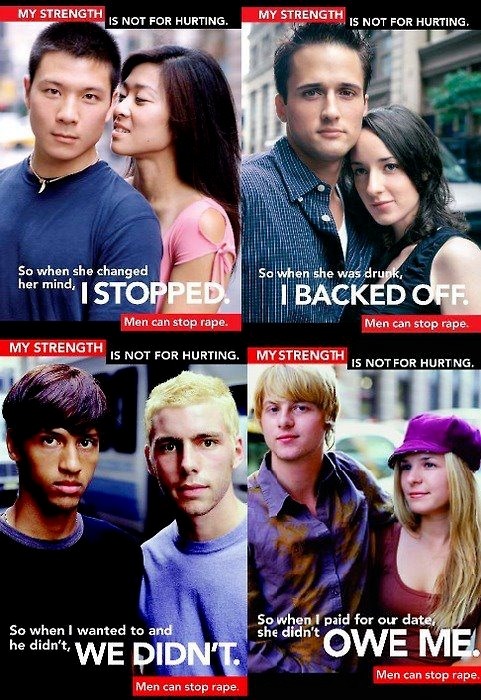
There have been some lovely anti-rape campaigns, but do they work? I haven't found any research on this. Please let me know if you find any. But half of changing societal norms is just complaining about it a lot, as far as I know. Women complained a lot about not getting to vote, and eventually public opinion swayed over to their side and they got it. (I should get a prize for the world's most over-simplified history lesson.) Blacks complained about getting treated badly until eventually people said “You know what? I guess that is kind of terrible.” And now LGBTs and their allies are complaining about not having equal rights, and by now nine states have legalized same-sex marriage, and my high school's homecoming king last year was gay, and maybe we'll even get around to accepting the LGBTIQQA folks as well. So I don't know what works and what doesn't. I don't know if the media works, or if reducing poverty works, or just complaining a lot works, or even if sexual education works (there's a chapter on sex ed in Half the Sky – it appears to be controversial, while general education for girls is quite successful). The one problem described in the book that I truly believe to be a feminist issue is the one problem that we have no idea how to approach. So... don't stop complaining. Keep being feminist, because as far as I know, that works as well as anything.

There's nothing wrong with a little feminism to try to reduce the number of rapes, convince the Republican party that we have the right to birth control, or discourage the idea of gender roles and the obligation of looking nice. But I'm slightly concerned that selling Half the Sky as a book on feminism is actually beside the point: it's mostly about poverty. I don't want people to donate money to sex ed if it turns out iodine tablets are hugely more effective and cheaper. That's all. There's nothing wrong with feminism, but third world countries have bigger problems.

What I may have forgotten to mention is that I really appreciated this book partly because (unlike other books that talk about how horrible the world is), it actually offered real solutions that seem to be particularly effective, such as microfinance, milking the Flynn Effect for all it's worth including my pet favorites, iodine and nutrition, and direct, effective charities. The last chapter is entitled “What You Can Do,” which is a go-forth-and-change-the-world sentiment that I appreciate.
In the meantime, don't forget to donate to charities that attack what is most important. According to GiveWell.org, the most effective charities this year are the Against Malaria Foundation, GiveDirectly, and Schistosomiasis Control Initiative, which you can also read about here: www.givewell.org/charities/top-charities.

I have a lot of things I need to blog about and not enough time to do it, but next up is an update on my ski trip, a post entirely about charity (and why the penny is useless), and a post about optimism (and why I think feminists often over-react, because people aren't intentionally mean).


Saturday, February 23, 2013

England


Last week I went to England with my class (1SB, which means junior year (1) of the science track (S), along with a class of 1L (literature track), a class of 1ES (economic-social track), and a class of 1STMG (science and technologies of management). We were in two different buses, so it wasn't too crowded, although I did get extremely fed up with the slow pace and amount of waiting that always results from disorganized school trips and too many people who don't know what they're doing.

We spent the first day in London and saw the British Museum and a Museum of Natural History, neither of which were terribly interesting given the packets of worksheets we had to fill out and the sleep-deprived state we were in after the night crossing of the English Channel. Yes, we had rooms with beds, but I can assure you that not very many people slept.

After London, we drove to Warwick, where our host families were. I have heard that many English host families are extremely odd, because French schools pay these families to feed and lodge French students for a week, and thus they are sometimes seedy people in need of a little extra cash instead of the kind, educated, philanthropists that make up the majority of volunteer host families. I have to say that our family held true to form. My favorite moment in that house was when Julia (my BFF – best French friend – and roommate) opened a cupboard in our room and screamed.

Moral of the story? Never look in closets of people you don't know.

Our host was an elderly retired woman and, for the first half of the week, her middle-aged daughter who was back from Dover for a visit. I've heard most Brits come across as cold and overly proper, and conversely Americans seem like golden retrievers to Brits, that is, overly friendly and a little stupid. Our interactions followed this pattern pretty well. I was shocked that she didn't eat with us, cleared off the table, and acted like we were at a hotel, and I got the impression that she wanted to keep our socializing to a minimum. Oh well. We ate decently despite all I've heard about terrible English cuisine, and we had beds to sleep in and a shower, even though she insisted that we shower at night. It was certainly an experience that reminded me how lucky I am with my host family in France.

On Monday we went to Cadbury World, where I dressed up like a pirate


and otherwise made a fool of myself, and we toured the chocolate factory. As far as museums and factory tours go, it wasn't bad, because we got free chocolate. In the afternoon we walked all over Bournville to take advantage of the snow.

SNOW! 


For a California girl, even a measly few centimeters was pretty exciting. We had snowball fights all day, with even our adorable physics teacher participating.
Me and Julia:
 This is me trying to warm up my hands after a snowball fight:

I don't have any good pictures of the snowball fights because no one wanted to endanger their camera, but here's a picture of my adorable physics teacher with my two BFFs:


On Tuesday we drove several hours to Manchester, a gloomy industrial ghost-town of sorts that was a big deal back when England was a major textile exporter, but now there's not much of interest in Manchester. We went to the Museum of Science and Industry (MOSI), and I can't say that was too interesting either. I like science, don't get me wrong, but it was a museum aimed for either a little younger or a little less educated than I. The one great thing about it was a skit put on for a group of elementary school British kids, that immediately drew the attention of all the French high school kids and we ended up doubling the size of the audience. It was to explain how trains work to little kids, under the form of a mean boss trying to educate a clueless worker who wanted to become a conductor. The clueless worker was one of the best comic actors I've ever seen – I really think he missed his true calling by working at a museum instead of being a stand-up comedian. He had the greatest facial expressions and had amazing slapstick skills, managing even to fall off the train looking convincing and comical without hurting himself.

The other great thing about MOSI was playing hide-and-seek in the trains with my friends, which meant we didn't fill out our worksheets at all, but we were already sick of spending our England trip complying to such busywork.


Wednesday was my 18th birthday! We spent the morning at the Museum of Transport in Coventry, which was nice if you like old cars but I don't, and then in the cathedral, which was bombed out during WWII and rebuilt afterwards. In the cathedral there was a beautiful Boston piano that I was drooling over since it's been half a year since I last got to play. When someone mentioned to my physics teacher that I used to play piano for a church and was longing to play, he said “Hmm.... that would be a good birthday present, wouldn't it?” and wandered off to find the caretaker of the church. He was an extremely kind old gentleman with a great (very British) sense of humor, or humour I suppose: “Do you, by any chance, have your birthday exactly once every year?? Astonishing. Because you know, I am very old, and by now I seem to get TWO birthdays per year.” Long story short, I was soon seated at an open piano, and sat down and played the one thing my fingers remember how to play: the introduction to Bring Me to Life, by Evanescence. You can see in this picture my other BFF and roomie took (let's call her Rihanna, since all names in this blog are made-up) that everyone in my group had sat down in the pews to watch me.

Fortunately I hadn't even noticed them, or I wouldn't have been able to play anything at all, but suffice it to say that I was quite embarrassed upon looking up, realizing that I had an audience, and realizing I could play literally nothing else unless I had some sheet music in front of me. That was awkward kids, thanks for listening to my 30 seconds of playing...

After the cathedral, we had the afternoon free for shopping in Coventry in the snow! I was pretty excited that it was snowing. In the words of my physics teacher (translated, of course): “You don't ever get snow in San Francisco, do you?” I guess it may have been obvious by the way I was trying to catch snowflakes on my tongue and finding patches of unmelted snow to make snowballs with. Fortunately I've pretty much come to terms with making a fool out of myself. We took a group picture on the steps of the old bombed-out cathedral, and you can see that it's snowing, but it was warm enough that the first half-hour of snow just melted into cold slushy mud on the ground. I'm the idiot on the left who thought the picture was already taken and stopped doing the wave. And I have a snowball in my hand by carefully finding a bit of unmelted snow on some priest's tomb!


So, shopping – we went to Primark, which is the English version of something in-between Forever 21, Target, and Walmart, that is, reasonably fashionable garments in vast quantity and variety, but made very cheaply, of low quality, and costing so little you feel like you're stealing. In short, the perfect store for teenage girls. My own personal philosophy of clothes (in response to people who like buying high-end clothes that will last longer, and thus having to buy fewer of them) is that I am extremely hard on my clothes and will destroy them whether they're from Walmart or Neiman Marcus (that's a high-end store, right?), and besides I get bored of my clothes after a few years anyway and would prefer to buy new ones and waste less money overall on nice clothes. Anyway, so while Rihanna was buying out the entire store, I got myself a 1£ sweater among other nice cheap things and a birthday present for Sarah the other American, whose birthday is 5 days after mine. We went to a few other more upscale stores like New Look, that still had massive sales and were therefore not too expensive. New Look made my day because I met a cashier whose father comes from Sunnyvale, my city of origin! Our conversation went something like this:

Her (upon hearing our accents): Where are you all from?
Rihanna and Julia: France
Me: California
Her: Really? Where in California?
Me: Around San Francisco.
Her: Whoa! My dad comes from Sunnyvale.
Me: What?? Really? I'M from Sunnyvale!

It really made my day. Mostly I did not feel more at home in England than in France, even though I certainly had a refreshingly high level of confidence just going into Starbucks and ordering a coffee. (Yes! I still have a different accent than what they're used to, but at least I don't sound stupid now!) The different accents meant that I had to ask the English host family to repeat what they just said about as often as I have to ask French people to repeat themselves, and because I feel so at home in my host family in France, that meant England was not as refreshingly almost-the-US as I thought it might be. But it certainly was nice to find someone who actually knows Sunnyvale. As my mom says, San Francisco is just “some dinky little town to the north of us.” But it's actually a good point: San Francisco may be our “the City,” just like how for anyone in New York or New Jersey, “going into the City this weekend” means NYC. But the city of artists and hippies and social outrage and narrow European-style streets is actually a world away from the quiet, competitive, intellectually-elitist, technophile, suburban Silicon Valley that actually represents my home. //End tangent.

Here are my friends and I at Starbucks. Starbucks is even more expensive in England than in the US, but it was worth it. Chai latté, yum.


Oh and here's a picture of the weird lunch I got:


I was planning on getting some Subway, but seeing the pictures on the menu, it was clear that Subway wasn't at all like how it is at home – they only have soft white fast-food bread, and it looked more like McDonald's sandwiches than the garden of deliciousness that it is back home. So I ordered a meat pie from somewhere sketchier, and it would've been good if they hadn't given me four ladles of gravy on top. I guess I should really learn to say “Stop! That's enough gravy!” at some point, but I kept watching with fascinated horror to see when he would stop.

After shopping and Starbucks, we went home and had dinner. After dinner, there was no cake. If I were a host family, I never would've let an exchange student's birthday go by without cake, but I already mentioned she was a little weird. Then we went immediately to bed, obviously, without partying at all because we are good kids.

How does it feel to be an adult? Well, pretty good. February 13th especially was heart-warming, because my classmates sung Happy Birthday to me (in English!), my teachers gave me a card, my friends gave me presents and sweet cards as well, and everyone really made me feel like a loved and accepted part of the class, which as an exchange student means I've succeeded, and as a human being makes me feel warm and fuzzy inside.
Look! I have friends!


Otherwise? Nothing has changed in the short term. I'll continue to go to high school, continue to be under the responsibility and direction of my organization, my school, and my host family, and continue to not have adult superpowers. (Wait, you mean I don't get to know all the secrets of the universe upon turning 18? What is this BS? I thought adults had all the answers! What's the point of getting old if I don't become omniscient?)

But it actually does feel a little different. I have the right to do what I want to within legal bounds (except buying alcohol once I return to the States) and the right to make my own decisions. On legal grounds, I'm now on the same footing as adults, and feel that that will make a difference for me when adults disrespect me just because of my youth. One interesting thing about my recent delve into feminism is that I've never felt disrespected because of my sex, and therefore have wondered from time to time if this (feminism) is still an issue. But age-ism, something that no one writes books or holds protests for, is something I've been acutely aware of all my life. Have you ever noticed that adults have the “right” to be downright rude to children, even unprovoked? I'll take a recent example:

The other day, my host sister and I walked out of our high school through a different door than we usually use, the door next to the administration offices. The secretary immediately got up and yelled at us. This is a translation, but I'll do my best to not change the tone at all: “Excuse me??? [indignantly] Stop right there! Since when have students have the right to use this door?!? This door is only for teachers and parents, not children.” This was delivered in a tone of voice I would describe as angry, indignant, disparaging/derogative, and rather affronted. Now, imagine for a moment that the door was only for staff, and that parents weren't allowed through. What would the secretary have said if a parent walked through the door? Probably “Excuse me, sir/ma'am, but this door is actually only for staff. I'm sorry for the inconvenience, but if you could go around to the other door that's located on the other side of the building, that would be much appreciated.” The parent would get the benefit of the doubt, while teenagers are always instantly seen as delinquents, or deliberately defiant and disobedient. The truth is that we didn't know we weren't supposed to use that door, and that we've never done anything against that secretary. She had no right to be so rude to us, and it was only socially acceptable because we're kids. I'm not even going to go into the fact that the only reason students are barred from using that door is to lower us, to make us less human than the adults. Just focusing on the actions of the secretary will do for a blog post that supposedly was about England, not ageism.

Nothing has changed since – I still look like a 16-year-old. But now I'd really like it if I could start fighting against this ageism, this very common discrimination that has never been seized by the media. A simple “Excuse me?” and request to be treated more politely might go a long way, you never know. The knowledge that, according to the law, I am now just as much a person as any other human being on the street is valuable just because of what it does for my confidence. I'll let you know how this plays out in real life. //End tangent.

Thursday was Stratford-Upon-Avon, which was the most uneducational potentially educational event of the entire trip. Stratford is very commercialized and touristy, and is more about the gift shops than about Shakespeare. What I particularly disliked was that there was no mention whatsoever about the mystery of who Shakespeare actually was, although after a quick consultation of the all-knowing wikipedia gods (link) I discovered it's a much less credible conspiracy theory than I had always thought. I had heard of the “Who was Shakespeare really?” question as an educated person's acknowledgement that we don't really know, but apparently it's a less well-supported theory than that. Anyway, the gift shops were okay, and there was a river with really aggressive geese, and we took another group picture:


That night we had fishsticks, which is one of the very few foods I simply cannot force myself to eat. I'm not a picky eater and am willing to eat foods I don't like, just because for me it's not the end of the world (nourishment is nourishment), but I simply can't eat fishsticks. Ick.

On Friday we said a breezy goodbye to our host. I heard in other families they got hugs or touching farewell sentiments, but we formally thanked her for her hospitality and walked out the door without looking back. It's a shame I didn't get along with her, because I had really been looking forward to discussing things in my native language. I would've been ecstatic to fall into a family interested in politics or philosophy or linguistics or anthropology or history or any of the many humanities subjects on which I can speak passionately, if not expertly. But alas, we did not exchange any more meaningful ideas beyond her telling us that we weren't allowed to take our showers in the morning.

We spent Friday in London, seeing Buckingham Palace,

 the changing of the guard, and the poor dehumanized soldiers who make up the guard.

Most of us have heard before of this phenomenon – the soldiers who aren't allowed to smile or react in any way to the tourists milling around and taking pictures with them.


I completely didn't expect this, but seeing this young soldier up close just made me sad. What a job it must be to have to endure that all day: the endless colors and noise and laughter turning around you, but being isolated behind a poker face and the interdiction of interaction. It's dehumanizing, the way people swarm around him and take pictures with him, acting like he's an object. I think that's why it's fascinating to us, because it's a human being acting like an object, but to me it was depressing and not funny, sort of a sad metaphor for life. We try to interact, but we're all really complex human beings trapped behind our own faces, unable to fully communicate who we are to others. Knowing that a little autism streak runs in the family, I make an active effort to remember to put myself in others' shoes and remember that behind every face is a brain and a bundle of emotions as well. Sometimes it feels like staring infinity in the face, when you are in a crowded room or walking down the streets of a big city and realizing that all of this meatbags around you are actually entire people with entire lives. It's a scale of consciousness that boggles the mind.

Credit: asofterworld.com

Luckily for me, I wasn't the only one who felt this way, and in the back of the crowd found myself next to a classmate who said “Kinda depressing, isn't it?” I'm not the only one.

The changing of the guard:


And I discovered that marching band has ruined me for life. I was completely unimpressed by the marching band and the guard. Look at those horn angles! Despicable! And they used lyres! Dear lord, what would Mr. Burn say... (For those of you non-band kids, lyres are the little music stands they have pinned to their instruments. And lyres are cheating. You should be able to memorize your music!) The music was pretty good, especially the piccolist, but her posture was shameful and her hand position even worse. She held it with flat, lazy fingers, as if it were actually heavy. (No piccolo jokes allowed, but it's the lightest instrument in the band, lighter than a baritone mouthpiece.) The guard impressed me even less. They couldn't dress their lines and didn't have even spacing, either. Their movements with their guns were synchronized with the beat, but they obviously hadn't decomposed their movements or learned to subdivide in their heads, because the beat synchronization didn't go beyond that: it was fuzzy and sloppy. I was seriously disappointed. Buckingham Palace attracts an enormous number of tourists, and the guard can't even learn to have the precision of a high school marching band? What is the world coming to? Daemon, my former drill sergeant, would have flayed them alive and then made them do 200 pushups if he had seen such lax behavior.

The rest of our day in London was spent at a boring slavery museum and walking through the city to see famous things like Big Ben.


That night we ate at a diner. Fishsticks. Again.

The ferry on the way home was significantly less restful, as we all slept on the floor in one big room instead of our 4-person rooms we had on the way over. I have no problems with sleeping on the floor – a useful legacy of growing up with backpacking – but we didn't have blankets and it was freezing.

All in all, I wasn't sad at all to leave England. It was nice to speak freely to strangers when ordering coffee or asking for a cigarette (not for me; I don't smoke), but English people are standoffish and unfriendly and I was sick of boring museums and not being able to spend my time in England as I wanted to. I will never go on a school trip like that again, since I am so used to travelling on my own and having much more freedom to do what I want that school trips make me feel frustrated and confined. I am pretty sure that I will never live in England, and never understand how my mother survived her 5 years in Southampton. It was a great trip for bonding with friends and getting up to mischief, but I was really glad to get home. And the fact that I can call this “coming home” is something special too. Not everyone can feel like they're coming home when they return to their host family.

It also made me rethink my hatred of not having perfect French. Yes, it's true that I can't make my points as clearly and well-said as I'd like, and that this takes away from my already-low level of confidence. But in England, the fact that we speak almost the same language but not quite means that we picked up on bizarre social vibes from each other. Little things in their words and expressions that are probably perfectly normal I perceived as unfriendly or odd, and I'm sure the reverse was true as well. So maybe the fact in France it's already obvious that I'm a foreigner and come from a completely different cultural background actually helps in mutual charity and understanding.

Or, in other words, “Ils sont bizzares, les rosbifs, eh ?” as my frisbee coach said. “Rosbif” – roast beef – is what the Froggies call the Brits. So yes, the Brits are indeed pretty weird.

Some other pictures that didn't make it into my giant wall of text:
 Fancy red telephone booths!
 The state of our room before packing up to go home...
 Me with some friends
Me climbing on a thing near Buckingham Palace, like a cool kid


 Me at a "bar" in a museum, chatting up the "bartender"


So there goes my England trip. Tomorrow I'm leaving to go skiing again, so next week you can keep your eye out for a Méribel, Take 2 post and a book review post of Half the Sky, a book on feminism my aunt sent me for my birthday. I don't intend to turn this blog into a book review blog and I certainly don't have time to write reviews of all the books I read, but I've been spilling my recent ruminations on feminism onto this blog so I thought it would be appropriate.