Showing posts with label charity. Show all posts

Sunday, March 24, 2013

Charity

I recently mentioned the importance of “charities that attack what is most important.” This post is a continuation of that, both to expand on the philosophy of charity and on addressing money with logic.

Most people know that the US penny is useless. There are many arguments for its discontinuation, which are nicely summarized here: http://en.wikipedia.org/wiki/Penny_debate_in_the_United_States#Arguments_for_elimination
and I have excerpted the three strongest points to introduce the subject:

  • Production at a loss — As of February 2011, it costs about 2.4 cents to mint a penny.[5] In 2007, even the price of the raw materials it is made of exceeded the face value, so there was a risk that coins were illegally melted down for raw materials.[6]
  • Lost productivity and opportunity cost of use — With the median wage in the U.S. being about $17 per hour in 2011,[7] it takes about two seconds to earn one cent. Thus, it is not worthwhile for most people to deal with a penny. If it takes only two seconds extra for each transaction that uses a penny, the cost of time wasted in the U.S. is about $3.65 per person annually,[8] about $1 billion for all of the USA.[9] Using a different calculation, economist Robert Whaples estimates a $300 million annual loss.[10]
  • Prices would not be higher — Research by Robert Whaples, an economics professor at Wake Forest University, using data on nearly 200,000 transactions from a multi-state convenience store chain shows that rounding would have virtually no effect. Consumers would gain a tiny amount – about 140¢ or $0.00025 per transaction.[13]
I invite you to scroll down the same page and read the arguments for preservation as well, but they are not strong or numerous, and appear to be either an exact opposite claim to point number 3, but less.. intuitive and well-cited, or the value of popular support. Clearly since two bills to remove the penny from circulation have already failed, popular support is the only thing preventing this very logical move. This is, of course, the good old traditionalism that powers the American right. We can't change things, because, well, they've always been that way! (In my opinion, this aversion to change is the root behind the gay marriage opponents and many other social freedom debates as well.) Anyway, my political biases aside, it is clear that the government would save a bit of money if they stopped minting pennies.

Maybe it isn't important. It is an insignificant fraction of the budget, after all (~1.6 x 10⁻⁵ %). But the point is, why don't we deal with things that are easy money-savers before arguing about whether we spend too much on the military or on teachers' pay? I know, I know, it would be more effective to stop producing trillion dollar planes that don't work, but if we're actually serious about being mad about the state of our budget, we should do everything we can (if it's worth the time for Congress to pass it – who knows, it could actually not be worth it, since political operating costs are fairly high – anyone have statistics on this?) to eliminate illogical spending wastes.

People tend not to think very logically about money. Another example I'm going to throw in here because it's very common is the Sunk Cost Fallacy. This fallacy shows up when people keep throwing money at a problem to try to rescue it, simply because they've already spent so much on it, like not pulling out of your business in time as it's going bankrupt. The same fallacy works in other situations. For example, “Sally, clean your plate! There are starving children in Africa!” Well, if you are against putting leftovers back in the fridge (which has always been my family's solution), you have two options: either you finish the plate, or you throw it away. The starving children in Africa will in no way be affected by this decision, and the money at the grocery store has already been spent, so literally the only difference in outcome is whether Sally learns to ignore her stomach's 'stop, we've eaten enough' signals, eats too much, and gets fat later in life, or not. If she throws away her leftovers, that will make no difference whatsoever to the shopping money or to the children in Africa.

Here's my utilitarian theory about money: money should be used to create the most good possible. This is one of the important differences between Republicans and Democrats, that Republicans believe it's more important to spend money on military and counter-terrorism (because Republicans operate under the world-view that the zombie apocalypse is going to happen any day now), while Democrats believe it's more important to spend money optimistically on making the future brighter, rather than protecting against the forces of evil: education, social liberties, etc. These are different viewpoints, sure, but there are simpler, smaller questions that can be tackled with this sense of utilitarianism and be resolved.

For example, charity. Let's say that you have chosen to donate to an animal shelter, because you like animals. There is nothing wrong with this; it is nice to rescue animals. Now, for the purposes of this thought experiment, I'd like us to stop talking in dollars, because I'm now living in France and I get confused between euros and dollars. Instead, let's use dead children as a unit of currency. I highly recommend you go read that article explaining the rationale for it, but to summarize, a DC is worth $800, and in smaller denominations we have “Four dead puppies to the dead child, since dogs cost a bit above $200 to keep alive in an animal shelter. There are two burnt rainforests per puppy, and five infected wounds per burnt rainforest.” This puts purchases in a realistic light (the light of opportunity costs!), as we often disassociate the dollar with the things we can do with it. For example, we might say “These shoes are only $15, which is pretty affordable. I think I'll buy them.” without saying “I could also buy a $15 rice cooker, which would then allow me to make my own Chinese food instead of going out to restaurants, and within a year I will have saved $30 which is enough to pay for my rice cooker and a pair of shoes.” That is maybe a less-than-ideal example because it focuses on the profitability of an item instead of its actual utility value, but you get the point. The purpose of using dead children as currency is to compare purchases with actual values instead of with imaginary numbers (what does “This is worth $800 dollars” even mean? Not as much as “This is worth 1 human life.”). To quote the guy who came up with it, “"Doghouse that costs 250,000 pounds" might not carry the proper punch. "Doghouse that costs 500 dead children" does.”

So, you decide to donate one DC to your local animal shelter. This is great, but even though puppies are cute, is it really better than saving a child? Or, to put it how I wrote it last year for my humanities presentation final:
Charity is a truly great thing, and we should all give to charity. Furthermore, we all want what money we can afford to give to be of greatest effectiveness, right? If you can give 5 dollars and save a child's life, you'd rather do that than give 5 dollars which will allow some new flowers to be planted at the senior center. A lot of people donate indiscriminately – they cannot say no to people on their doorstep with clipboards, so they donate a small amount of money to many diverse charities, which is less effective than concentrating their money. Furthermore, you should do research and decide which charity is the most worth it to you. I rather suspect, if you actually think about it, that you will not choose to give your money to the humane society if you're trying to decide between that and, for example, Village Reach, which brings filtering systems to African villages to provide them with longlasting clean water.
Actually, if I may share with you all, (CHARITY SLIDE) givewell.org has spent thousands of hours figuring out which charities are the most effective. Village Reach was their #1 choice last year, and now it is the AMF. This seems an entirely logical way to choose charities, right? But if you hadn't thought about it,
hey look, PUPPIES! (PUPPY SLIDE). They're so adorable. You can't stand the thought of a puppy dying. So you donate. And the childers in Africa still have no clean water and die of malaria. This is why you should think logically in all aspects of your real everyday life, to help optimize the world we live in.

Okay, so maybe I was a little harsh and much less concerned with citations than I am today, but it's true – you can't separate your donating to the humane society from the fact that you could've donated to a more worthwhile cause, where worthwhile means “improves the planet more in ways (that you have decided are important).” (Because dollars actually correspond to real life economic power, like Dead Children.) Of course “worthwhile” cannot be objective. I believe my values are pretty good: improving quality of life for sentient beings. This principal guides a lot of my other beliefs as well, or can be used to justify them. For example, I am pro-choice: forcing an unwilling woman to come to term with her baby significantly decreases both her quality of life and her future child's, while an abortion has a much smaller negative impact on the woman's health (physical, mental, and/or emotional, depending on the individual), and ending the baby's life does not count because it is not yet sentient. I can't find a citation for it at the moment, but I remember reading that during the first trimester (ideal abortion time), a baby has a less sophisticated neural network than a squirrel's. Therefore, unless you're a vegetarian who doesn't approve of killing any animals at all, it seems a little hypocritical and misinformed to value a fetus just because of its potential to later become a human. I'd prefer to abort the less-than-sentient fetus, wait until the mother is at a better time in her life (economically, psychologically, etc.) to have a child, and then have a kid who will have a much better quality of life than the first fetus would have had, and the mother's quality of life will be better as well. Considering the billions of sperm that don't become people, judging the loss of a potential human as murder seems silly.

Now, another point to make: many people say that a human life is priceless. You can't ask how much you would pay to save someone. People assume that human life is worth more than any amount of money. This demonstrates once again how we forget the actual value of the dollar, that money isn't just money. Money corresponds to resources, and thus a human life can't be priceless, because by taking away lots of resources, you could hurt a larger number of people than you're trying to help. For example, if the government decides to spend a million dollars on a rescue mission for a diplomat in a war-torn country, that's a million dollars that could've gone towards more effective quality-of-life-raisers, like water filters in Africa and ramen noodles in food pantries for homeless folks. That's a million dollars that translates into 1250 Dead Children. So unless this particular individual was worth 1250 other people, it was a bad investment, and life does have a price after all.

Now, that's a valuable argument anyway. I don't think there are very many people, if any, who are worth 1250 others, but you have to admit that a privileged rich white male 25-year-old in America who's going to a good college and has a great future ahead of him has a life that's worth more than a 90-year-old who's already dying of old age, or a clinically depressed suicidal person, or a Chinese factory worker who doesn't have the time or energy to pursue intellectual or artistic passions. A life should be worth more if it has more happiness and fulfillment, and should also be worth more if their chances of survival on an everyday basis are already greater. (For example, the 25-year-old is already going to live longer than the 90-year-old, and he has a greater chance of survival for the rest of his 60 odd expected years of life than a 25-year-old with a worse quality of life in Africa who is more likely to die of malaria or AIDS or worms.) I'm not saying that the young white guy is intrinsically worth more, but that his life is, because he has a higher quality of life than the others. So this argument for the complexity of how much a life is worth can be used against the next logical step of the DC thought experiment, which says you shouldn't spend any more than $800 on medical care, because it would be an inefficient use of money to improve lives. A fulfilling first-world life may well be worth significantly more than $800. (Another argument is that one cares more about one's own life than a randomly-selected stranger, which is perfectly valid and normal.) I can't really judge that, but it's a good thing to keep in mind so you don't take the argument too far. This isn't even taking into account the fact that over-population is bad, and therefore it would probably be better overall to limit the number of people on the planet and devote more resources to their quality of life.

(This is, of course, in contradiction to the repugnant conclusion, or the mere addition paradox. Since I find it badly explained by these two links, I'll try to rephrase it: Imagine a World A, where you have a small but happy population. Now imagine a World B, where you add a few people who are slightly less happy. The average happiness becomes lower, but because these people are still glad to exist (i.e. they don't kill themselves), it must still be a better world than World A. Now imagine a massively overpopulated World C where we have a large number of very miserable people whose lives are just barely worth living. They would still rather exist than not exist, and the total happiness is greater than in World A if the population is sufficiently large, so clearly this heavily-populated world is better than World A, the happy world with not very many people. Does this seem right to you? Probably not. For me the main fallacy is in the definition of a “life worth living.” Your life might not be so bad that suicide looks like a good option, because evolutionary psychology is a thing and tends to make us suicide-averse. (Anyone who isn't suicide-averse gets taken out of the gene pool – see how it works?) However, a life can be not worth suicide but still not worth getting started. The example I gave earlier of a kid who should be aborted because the mother isn't ready is a perfect one. He shouldn't be culled at age 20, but he should never have been started. The potential of intelligent life doesn't mean there should be life, if that life is not going to be a high-quality one.)

Anyway, so money should = greatest utility, where utility is about improving quality of life, at least if you have the same values that I do. What this means in practice is that you are responsible for what your money does, which is a concept many environmentalists have adopted in terms of not supporting unethical farming practices with your purchasing power. Your money should support your values: if you are against underpaid labor, you should buy stuff that is only made by well-paid labor, at least if you think that's a cost-effective way to increase wages. If you believe that the greatest thing in life is puppies, you should support humane societies. If you, like me, believe that human lives are the most precious thing (to us, logically, because we are humans and evolutionary psychology exists), then you should support everything that makes our lives better, starting with the most cost-efficient (vaccines, for example), but also including preservation of nature for our enjoyment and our future, education, art, scientific advancement, and other things that are also good for us.

That is a difficult line to draw – I know that music is good for the soul and I believe that we should continue to have it in our society, so donations to the San Francisco Symphony should be a good thing, right? (Or whatever you think would be a more cost-effective donation to the arts, the psychological health of the population, and the eventual advancement of society.) But keeping in mind everything I said earlier, it sounds wrong to donate half a dead child to a musical organization. However, if we don't maintain our society and our progress through funding of scientific research, the arts, and everything else that makes us flourish, where would we be? The Renaissance wouldn't have happened. The Industrial Revolution wouldn't have happened. The Information Age and the frigging Internet wouldn't have happened. And we would be in a much worse position to help poor children in Africa, let alone the fact that our quality of life is much better now than it was in the Middle Ages. Where exactly to draw this line, I don't know. Personally, I wouldn't contribute to things that don't seem to contribute either to helping people in the moment or helping our society progress. I would donate to the Against Malaria Foundation and probably to scientific advancement (I believe my brother is a fan of the Machine Intelligence Research Institute) and possibly to the SF Symphony, but not to the humane society (puppies? Who cares?) or to planting flowers at the senior center. But the final answer is that I don't know what would be best for this balance of immediate effectiveness and future pay-offs. I know it's important, so important that you should stop thinking in dollars or euros and start thinking in Dead Children, but all I can say as final advice is:
  • Donate to your values; don't donate thoughtlessly because you can't say no to a guy with a clipboard.
  • Donate to very few organizations, and donate to the most well-known and powerful ones instead of inventing your own new movements, because you want your money to be more effective and spent more on the charity itself than on administrative overheads.
  • Donate to the most effective charities (see GiveWell; also Giving What We Can)
  • Get rid of the penny and other stupid wastes of money (although that was really just a fun facts introduction to the topic of money fallacies)
  • Stay real – donate to the advancement of society as well: science, the arts, etc.
  • Don't think that charity is all about going to Ethiopia and feeding the poor. See 80,000 Hours for stories of people who became bankers and lawyers and doctors in order to make lots of money and make a greater difference through charity by tithing (giving 10%).
  • Don't be afraid to give generously if you're rich, for money is only correlated with happiness up to about $75k/year, and after that point people are more satisfied by spending time with their family and doing fulfilling things like giving to charity.

That's all I got. Go forth and be a good person. Thanks for reading.

Thursday, March 14, 2013

Half the Sky

Sorry my “travel blog” degenerated into a political musings platform! I swear I didn't mean for this to happen. But here goes, more thoughts on feminism, etc.

The need for feminism comes in many different forms. The one I've mostly been thinking (and writing) about lately is the obligation of femininity kind of problem. Take a look at this great article, You Don't Have to Be Pretty.

[A discussion about leggings] got me thinking about the pervasive idea that women owe it to onlookers to maintain a certain standard of decorativeness.
Now, this may seem strange from someone who writes about pretty dresses (mostly) every day, but: You Don't Have to Be Pretty. You don't owe prettiness to anyone. Not to your boyfriend/spouse/partner, not to your co-workers, especially not to random men on the street. You don't owe it to your mother, you don't owe it to your children, you don't owe it to civilization in general. Prettiness is not a rent you pay for occupying a space marked "female".”

This is what I've been thinking about, because this is what I've been experiencing. For the first time in my 18 years of life, I feel like it was unfortunate to be born a girl. In the Bay Area, the way you dress is a free choice, even if you still are aware of social hierarchies (and jealous of the “popular girls”) and feel pressured to dress a certain way. But in France I really never felt like I had the choice. I know, it's not the Taliban. But social pressures are hard and important and matter a lot more than it seems like they should. So when people ostracize the poorly-dressed and ugly, you try your hardest not to be poorly-dressed and ugly, even if it's really not your cup of tea. This is not something that should happen. People have the right to not be interested in math and the right to not practice juggling as a hobby, and they aren't judged for these traits. You can even be a nerd and not like math. But for some reason, not liking fashion in certain cultures can come with other oddly unrelated assumptions: that you are antisocial (or socially inept), stupid (or nerdy, but not in-between), or come from a bad family, either too poor or too messed-up to dress well. It is for this reason that I've finally started sympathizing with feminism as a movement. I've never been against it, because I'm for equal rights of women. But I've never felt the need for it before, and thought it rather silly that people would get all up in arms about it. I viewed it as the equivalent of the Hispanics and blacks back home who sometimes discover in middle school that they can use their minority status to make the others (whites and Asians) feel uncomfortable: “Can I borrow a pencil?” “No, sorry.” “What, is it because I'm black?? Racist!”

People where I grew up are never shocked when teenagers express a wish never to get married or have kids. It's a typical “I'm going to have a big powerful career and do cool things with my life, instead of being boring suburban parents like my mom and dad” wish. But here, interestingly enough, I've been met time and time again with astonishment when I say I don't expect to get married or have kids. They usually don't understand at first, saying “Oh yes, a lot of people these days are skipping the getting-married step. It doesn't change anything except a few legal benefits, and then you don't have to go through with an outdated religious ceremony.” (Most of the French are extremely atheistic, except the old ones who are all Catholic.) So then I clarify: “No, no, I just don't think I'll end up spending my life with someone,” and they raise their eyebrows and say “Ah bon??” which means “Wait, really??”

So here there's a role to be filled: the Gender Roles that radical feminism likes to talk about but I had always rolled my eyes at, because when I was a little girl of course I could be an astronaut if I wanted to. French women are allowed to have any career they want – just so long as they stay feminine enough. They should like pretty clothes and strong men and want children. It's progressed a long way from the days when women couldn't vote, and it's much better than Afghanistan where women can be flogged and/or killed by the Taliban for leaving the house without a burqa. Which leads me to the second need for feminism:

My aunt Sara sent me a book called Half the Sky for my birthday, seeing that I was getting interested in feminism. This addresses the real live painful issues of feminism: the oppression in the Middle East, the human trafficking across Asia and Indonesia, and the maternal mortality rates and the lack of female education in Africa. It was a good book, well-researched and honest, and I recommend it. Here is my review of it, but it comes with a disclaimer: I have studied the subject much less than the authors have and am making only conjectures which should not be taken for the truth. If any of you are more enlightened than I am, please comment and tell me all about what I did wrong.

As far as oppression in the Middle East goes, I have nothing to say in defense of their culture. I don't know or understand the culture very well either, but it seems to me like it would be pretty terrible to be a woman living under the Taliban, and that this is just plain oppression of women by big bad evil people. This is one of the few real world instances where I don't see very many shades of gray – I can't really think of any possible way to sympathize with the Taliban.

About human trafficking: it is a terrible crime and ruins a lot of girls' lives. According to the book, in concrete numbers (not percentage of world population), the current world sex trafficking trade is about ten times bigger (in number of victims per year) than the entire African slave trade at its peak in the 1780s. No kidding. If you have ever been like me and said that we don't need feminism anymore, than this is your call to –

Wait. Wait a minute. Sex trafficking gets fixed by feminism? Okay, I think I just discovered what my problem with books like this is: of course being kidnapped to become a prostitute is horrible. And we should really do something about it, considering the size of the problem. But is this really a need for feminism, just like convincing the Republican party that we have the right to birth control? To me that sounds sort of like saying that murder is a respect problem, and we really need to teach our kids to respect other people more. Like, um, yes, I guess more feminism and more respect aren't really bad things... but are you sure that's the issue at hand? I'm sure pimps are quite aware that everything they're doing is against women's rights. But I doubt that they're being pimps because they don't think women are as fundamentally valuable, sentient, and worthy as men. They're doing it because they can, because they need (or want) the money, because they have kids to feed or a drug habit to nourish. One of the stories in Half the Sky is about a Cambodian girl who got kidnapped, prostituted, freed by the authors of the book, went back to the brothel because she couldn't overcome her meth addiction, and eventually ended up in a managerial role, breaking in the newly kidnapped girls. This sounds more like individual acts of desperation and not really like a lack of feminism in Indonesia.

So what is the problem? Poverty, mostly. These girls mostly get kidnapped (according to the book) with a promise of a job in a far-away city as a dishwasher or a waitress. They tearfully leave their parents, promising to come home richer, and then get whisked off to a foreign brothel where they can't speak the language and can't escape.

Fortunately, the authors recognized that. My favorite part of the book was about microfinance, which seems like a brilliant idea and gets pretty great results. The idea, highly simplified, is this: you lend someone a very small amount of money when they present you with a business plan. With their $5 they can go buy wool to make string and sell it to other village women. When the woman has earned $10, she can come back, pay back her loan, and borrow slightly more money to make her business bigger. It really is microfinance, increasing by a small amount each time just to start these women off, and once they get used to borrowing, working, selling, and paying back, they are good business women with a life plan ahead of them, while it cost almost nothing to get them on their feet. The “teach a (wo)man to fish” proverb seems appropriate here. They get more respect from their families and more control over the education and up-bringing of their children. It's good all around from the feminist perspective – the woman doesn't need to prostitute herself or try to find a job that will end in kidnapping and a brothel. She earns more and can feed and care for her children better. She has more say in family affairs, and may even send her daughters to school. But all this isn't actually in the name of feminism. It's just in the name of quality of life and raising people out of poverty.

Is this a problem? Not really, I guess. Whether you call it feminism or helping the poor, it's essentially the same thing. It's just being smart about it. The authors know that you aren't going to help women in the Middle East by denouncing Islam as a horrible religion. Instead you can help intellectualism win out over terrorists by making sure babies aren't iodine deficient. This was also pointed out by my favorite blogger (props):

Iodine deficiency decreases a child's IQ by ten to fifteen points, and cheap, simple iodine supplementation of pregnant women and children can completely reverse that! This is a huge deal in places like Afghanistan where a very large portion of the population is iodine deficient, and some biodeterminist historians have tried to explain the continuing problems of those areas, all the way up to its current problem with terrorists, with cognitive handicaps due to lack of iodine.

And in case you didn't realize just how enormous and important 10-15 IQ points is, because you probably didn't, he also says:

Most people don't have a good intuitive feel for IQ. Just to help calibrate how much you should care about these, each extra IQ point is associated with about a 2% increase in lifetime earnings and a 2% increase in worker productivity. A 15 to 20 point rise in IQ, which is a little more than you get from supplementing iodine in an iodine-deficient region, is associated with half the chance of living in poverty, going to prison, or being on welfare, and with only one-fifth the chance of dropping out of high-school ("associated with" does not mean "causes"). The average IQ of a janitor is 92, the average of a doctor is 120, and the average of a Nobel Prize winner is 144. Because of the way standard deviations work, raising IQ by 10 points (a little less than the size of the iodine effect) sextuples (multiplies by six) the chance of having IQ > 140 and therefore in Nobel Prize territory.

So my favorite blogger and the authors of Half the Sky should get together and talk about how iodine deficiency is a large contributing factor to terrorism and crazy Taliban-ism. So, helping problems in the Middle East? Let's just remember to keep our priorities in line, and fix people's iodine, nutrition, education, and see how far that goes to fixing the oppression of women.

The same thing goes for medical issues in Africa. It's horrific. It really is. But the authors admit it:

...it's crucial to avoid exaggerated claims. In particular, advocates should be wary of repeating assertions that investing in maternal health is highly cost-effective. …the sad reality is that investments in maternal health are unlikely to be as cost-effective as other kinds of health work.
...As one leader in the development field said: 'Vaccines are cost-effective. Maternal health isn't.'”

I'm not against taking care of women dying in childbirth. But I'd like to suggest that it would be a better idea to start with what's easy and cost-effective: vaccines, education, and birth control. I'd also like to suggest that this, too, is not really about feminism. It's about poverty. Women aren't dying in childbirth because their husbands and fathers hate them. But right now in these areas, there's not enough money, not enough medical services, and not enough well-thought-out aid from developed countries.

Feminism is a concept of developed countries, more or less. So maybe the whole concept smells a bit ridiculous to me just because it's not really priority #1. If we start with what's relatively easy-to-fix and start in on the iodine deficiency and poverty, we pile on the birth control and sexual education, the general education, and cheap and easy miracle medicines like vaccines, water filters, and penicillin, we'll already have gone a very long way toward improving the quality of life of women (and men, and non-binary folks!) in Africa. Society drifts steadily left, and it seems to me that ending the oppression of women is a very natural step that comes with improved quality of life. Once you stop scrabbling in the dust to leave your mark on the planet before you die, you can start having dreams – ambitions! Women with careers! But when most of Africa is oppressed (by their poverty), it seems silly to me to talk about feminism as a problem in Africa, even though feminism isn't a bad thing.

But there is one other problem that does seem much more suited to the feminist movement: the rapes that appear to be commonplace in Africa. Half the Sky describes the really horrific and very common African medical problem, fistulas. A fistula is a hole in the birth canal that is caused either by rapes (more common when the rape is conducted with another object, such as a broom handle) or by unsuccessful births. The fistula patient then leaks her wastes constantly, and the smell and unpleasantness of this condition lead many families to drive her away. “The fistula patient is the modern-day leper,” says Ruth Kennedy (quoted in Half the Sky). Most fistula patients are girls who did not succeed in giving birth because they were too young, and their pelvises were not yet large enough to let the baby pass through. This can happen either if the girl is raped, or if she's married off too young. (Or if she's in a consenting relationship, although of course that raises the question of what the age of consent should be.) The root problem here is clearly a feminist one: somehow, we need to find a way to discourage rape, specifically in African cultures. Somehow, we need to convince African families to give up more of the few resources they have to girls' education and protecting their daughters. Poverty and crime are very strongly linked, even when the crime is not money-related. But I don't think rape, unlike prostitution, should be explained by poverty. Prostitution happens because no one has enough money (either the sex worker or the pimp or both), but rape isn't profitable. (Note: I am not saying prostitutes can't be raped, but I am making the distinction here because the root of one is poverty and the root of the other is a cultural problem.)

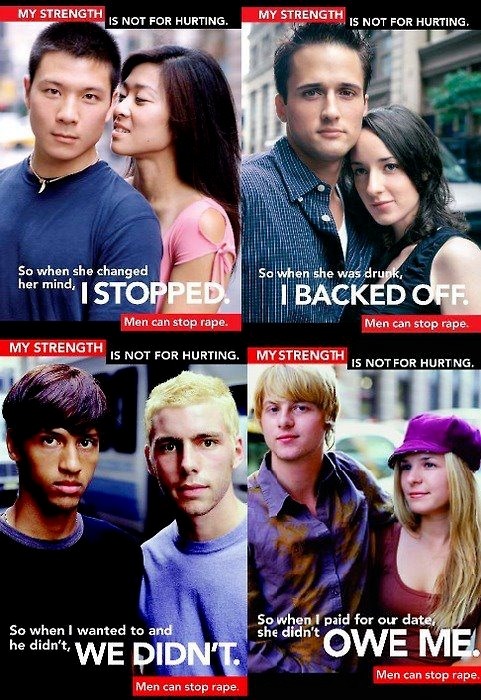
How do we make people respect women more? How can we decrease rapes, either in Africa, where it's badly needed, or even in “civilized” countries like the US and France, where it's also badly needed?
There have been some lovely anti-rape campaigns, but do they work? I haven't found any research on this. Please let me know if you find any. But half of changing societal norms is just complaining about it a lot, as far as I know. Women complained a lot about not getting to vote, and eventually public opinion swayed over to their side and they got it. (I should get a prize for the world's most over-simplified history lesson.) Blacks complained about getting treated badly until eventually people said “You know what? I guess that is kind of terrible.” And now LGBTs and their allies are complaining about not having equal rights, and by now nine states have legalized same-sex marriage, and my high school's homecoming king last year was gay, and maybe we'll even get around to accepting the LGBTIQQA folks as well. So I don't know what works and what doesn't. I don't know if the media works, or if reducing poverty works, or just complaining a lot works, or even if sexual education works (there's a chapter on sex ed in Half the Sky – it appears to be controversial, while general education for girls is quite successful). The one problem described in the book that I truly believe to be a feminist issue is the one problem that we have no idea how to approach. So... don't stop complaining. Keep being feminist, because as far as I know, that works as well as anything.

There's nothing wrong with a little feminism to try to reduce the number of rapes, convince the Republican party that we have the right to birth control, or discourage the idea of gender roles and the obligation of looking nice. But I'm slightly concerned that selling Half the Sky as a book on feminism is actually beside the point: it's mostly about poverty. I don't want people to donate money to sex ed if it turns out iodine tablets are hugely more effective and cheaper. That's all. There's nothing wrong with feminism, but third world countries have bigger problems.

What I may have forgotten to mention is that I really appreciated this book partly because (unlike other books that talk about how horrible the world is), it actually offered real solutions that seem to be particularly effective, such as microfinance, milking the Flynn Effect for all it's worth including my pet favorites, iodine and nutrition, and direct, effective charities. The last chapter is entitled “What You Can Do,” which is a go-forth-and-change-the-world sentiment that I appreciate.
In the meantime, don't forget to donate to charities that attack what is most important. According to GiveWell.org, the most effective charities this year are the Against Malaria Foundation, GiveDirectly, and Schistosomiasis Control Initiative, which you can also read about here: www.givewell.org/charities/top-charities.

I have a lot of things I need to blog about and not enough time to do it, but next up is an update on my ski trip, a post entirely about charity (and why the penny is useless), and a post about optimism (and why I think feminists often over-react, because people aren't intentionally mean).